When a Montana case raises questions about collectability, undisclosed property, financial disclosures, or related business interests, an online asset search can help attorneys organize the facts before deciding what investigative work should follow. The value of the search depends on a clear objective, accurate identity information, and careful verification of each lead.
What should an attorney define before requesting an online asset search?
The first intake question is: what decision must the search support? An attorney may need to evaluate collectability, locate property, assess financial disclosures, understand business interests, or plan further discovery. Defining that decision keeps the search focused on relevant people, entities, dates, and jurisdictions.
Unclear identities can produce records belonging to someone with a similar name. Aliases, former addresses, business names, changing ownership, and incomplete date ranges can also make a search less useful. We recommend giving the investigator enough context to distinguish the subject from unrelated individuals while sharing only information appropriate for the assignment.
A practical intake checklist should cover:
- Identity: Full legal name, known aliases, date of birth when lawfully available, prior addresses, employers, relatives, and known associates.
- Business connections: Companies, trade names, professional affiliations, partners, and entity locations connected to the subject.
- Case details: Case number, relevant transactions, known property, important dates, and the legal or collection question the search should address.
- Assignment limits: Confidentiality, privilege, legal-process requirements, jurisdictional limits, and any information that should not be pursued.
Attorneys should also explain whether the search concerns current assets, historical ownership, transfers during a defined period, or a broader relationship map. That distinction affects the records reviewed and the conclusions an investigator can responsibly draw.
Which records and online sources can help reveal possible assets?
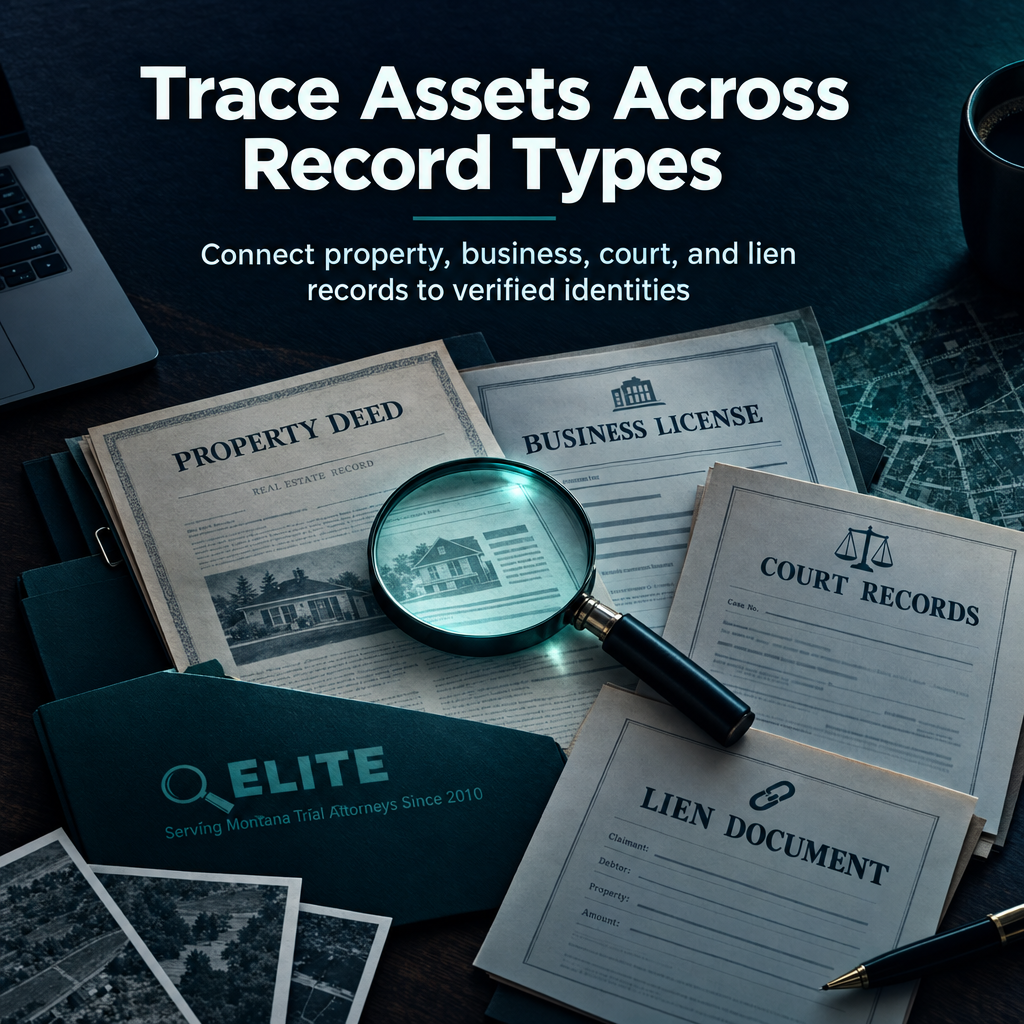
Lawful review of public records and online information can identify possible property, business interests, filings, liens, and relationships that warrant closer review. We organize the search around the person, company, property, or related entity, then compare names, locations, dates, and affiliations across relevant sources.
Depending on the assignment, useful sources may include property records, business registrations, court records, UCC information where available, licensing or professional filings, entity databases, and other public records. Historical addresses and date ranges matter when an asset may have moved, changed ownership, or been connected to a different business name. A source should be documented with its access date, record date, jurisdiction, and relationship to the subject.
- Identity: Legal names, aliases, birth information when lawfully available, and prior addresses.
- Jurisdiction: Montana counties, other states, and known business locations.
- Asset lead: Property, company, lien, filing, or other record requiring review.
- Verification need: The next record or investigative step needed to test the lead.
This structure helps separate a documented record from an assumption. An online asset search can point to a potential ownership interest, but it does not automatically prove current ownership, value, control, or collectability. For a broader discussion of attorney-focused searches, see our related guide on asset searches for Montana and Wyoming matters.
Public ownership and business records
Public ownership and business records can connect a subject to property, companies, liens, filings, or other interests that deserve review. Property records may help identify a recorded owner or transfer history, while business registrations and court filings may reveal entity names, officers, addresses, or related disputes.
These records still require interpretation. A filing may show an association, a lien, or a historical connection rather than present control, so we document the record and identify what additional confirmation is needed.
Identity and relationship matching
Identity matching reduces the risk of attributing another person’s records to the subject. We compare legal names, aliases, prior addresses, employers, relatives, associates, entity names, and historical locations rather than relying on a name alone.
Relationship links can help explain why a record deserves attention, but they do not establish ownership by themselves. Attorneys should ask which facts support the match and which parts remain an investigative lead.
How do Montana and Wyoming location details change the search plan?
Montana and Wyoming location details should be identified at intake because asset information may be divided among counties, communities, states, and business locations. Montana’s mix of urban centers, rural properties, and widely separated communities can make a single-address search too narrow for a case involving multiple residences or entities.
We recommend listing every known address, employer, property location, company location, and relevant community before research begins. Billings, Bozeman, Butte, Missoula County, Anaconda, and Baker may each matter when they appear in the subject’s history. A neighboring Wyoming residence, company, or property can also change the jurisdictions that should be considered.
Local context helps an investigator interpret a lead, but formal ownership and legal significance still require appropriate record review and attorney judgment. Elite Investigations supports attorneys in Billings and surrounding Montana areas, including Wyoming, so the initial assignment can identify the geographic questions rather than assuming they end at one county or state line.
County records and regional ownership patterns
County and community information helps determine where relevant ownership or transfer records may exist. An attorney should identify known Montana counties and communities, including Billings, Bozeman, Butte, Missoula County, Anaconda, or Baker when those places appear in the case.
Rural property, multiple county connections, business operations near state lines, and changing addresses can require a wider geographic scope. A location match remains a lead until the subject’s identity and the underlying record are confirmed.
Cross-border questions for Montana cases
A Montana matter may involve Wyoming residences, property, entities, or transactions, making cross-border planning part of the original request. Attorneys should identify known Wyoming locations and explain whether the assignment concerns current ownership, historical activity, or a specific transaction.
We treat location as a research direction rather than proof of ownership. The final assessment should distinguish a geographic association from a record that supports a legal or collection decision.
When should an attorney expand an online asset search into field investigation?

An attorney should consider expanding the assignment when identities conflict, ownership records are incomplete, present activity must be confirmed, a witness is missing, or a lead requires lawful verification beyond online research. The decision should follow the unresolved legal question, not simply the existence of an interesting record.
An online record may suggest that a person has an interest in property or a company. Evidence supporting a collection or litigation decision may require confirmation of timing, control, current activity, transfer history, or the connection between the subject and the record. We recommend asking for separate categories for confirmed records, reasonable inferences, and items requiring further investigation.
Elite Investigations provides related investigative categories that may fit different questions, including asset searches, bank account searches, background checks, surveillance investigations, witness locating and interviews, and legal investigations. Each option should be tied to a defined objective and handled within applicable legal and privacy limits.
Online review as an initial research step
An initial online review can organize public leads, identify likely entities or property, and help an attorney decide whether further work is justified. A useful deliverable may include the defined scope, source notes, potential asset leads, identity-matching observations, and unresolved questions.
That format gives counsel a practical basis for deciding whether to request additional records, interviews, surveillance, or another investigative step. It also prevents an unverified online reference from being presented as a settled fact.
Related investigative options
Bank account searches, background investigations, witness locating and interviews, surveillance, social media investigations, and due diligence may be appropriate when the online search leaves a specific question unanswered. For example, a possible current activity lead may call for lawful field verification, while a missing person connected to the matter may require witness locating.
These services are case-dependent. We recommend adding them only when the unresolved issue justifies the work and the requested method fits the attorney’s legal objective.
How should attorneys assess the reliability of online asset-search findings?

Attorneys should assess each finding by reviewing the source, record date, identity match, ownership or control link, jurisdiction, completeness, and need for independent verification. This framework helps counsel decide whether a record supports a legal step or remains a preliminary lead.
An old address, similar name, company connection, or social media reference should not be treated as current ownership without supporting records. Ask whether the source identifies legal ownership, a beneficial interest, a lien, a transfer, an association, or only a possible connection. The distinction matters because each category carries a different evidentiary meaning.
We recommend requesting a final report that separates confirmed information from unverified leads. It should identify source details, relevant dates, gaps in the record, and the next step that could answer the remaining question, such as an additional record review, interview, or lawful surveillance assignment.
Attorneys should also consider whether the search covered the jurisdictions and date ranges that the case requires. A complete-looking report may still be limited if it excludes a former address, related entity, neighboring state, or relevant transfer period.
What should Montana attorneys expect when they request an asset search?
Montana attorneys should expect the assignment to begin with a defined case objective, identifying information, jurisdictions, dates, and a requested deliverable. Before work begins, ask how findings will be documented, which sources will be reviewed, and which items require independent confirmation before they are relied on in a case.
An attorney-ready request can include:
- Subject identity: Legal name, aliases, birth information when lawfully available, and known associates.
- Known locations: Addresses, counties, employers, properties, and business locations in Montana or Wyoming.
- Relevant dates: Transaction dates, ownership periods, transfers, litigation events, or disclosure periods.
- Case objective: The decision the search should support, such as collectability, discovery planning, or property review.
- Requested output: Source documentation, potential asset leads, identity analysis, unresolved questions, and recommended next steps.
Cost and timing depend on identity complexity, jurisdictions, entities, historical date ranges, records requested, and any follow-up work. We recommend requesting a scope-based estimate rather than assuming a fixed price for every online asset search.
Scope, timing, and cost factors
Scope, timing, and cost can change when a subject has multiple names, addresses, companies, or jurisdictions. A historical search covering Montana and Wyoming may require different research than a focused review of one property or entity.
Ask what the initial assignment includes, what documentation will be delivered, and which follow-up services would be separate. Clear expectations help counsel evaluate the findings without confusing a preliminary lead with verified evidence.
Starting with Elite Investigations
Elite Investigations supports attorneys and law firms in Billings, surrounding Montana areas, and Wyoming. We recommend contacting our team with the case objective, known identity information, locations, relevant dates, and desired output so we can discuss the appropriate scope.
To discuss a Montana or Wyoming asset-search objective, call +1 406-698-8911, email info@elitepimt.com, or contact Elite Investigations. Our broader investigation services can also be considered when the online search identifies a question that requires additional lawful investigative work.
Frequently Asked Questions
What information should I provide before ordering an online asset search in Montana?
Provide the subject’s legal name, aliases, known addresses, birth information when lawfully available, businesses, locations, relevant dates, case context, and the specific decision the search should support. Better scope information helps us separate the correct person from similar names and focus on relevant jurisdictions.
What does an online asset search include?
An assignment may include lawful review of relevant public records and online sources to identify possible property, businesses, filings, ownership links, and related leads. Exact sources and deliverables depend on the defined scope, and a possible lead may require additional verification.
How much does an online asset search cost?
No fixed price should be assumed because cost can depend on identity complexity, jurisdictions, date range, entities, records, and follow-up investigation. Request a scope-based estimate from Elite Investigations before work begins.
Do you serve Billings, Montana, surrounding areas, and Wyoming?
Yes. Elite Investigations provides professional investigation services to attorneys in Billings and surrounding Montana areas, including Wyoming. Include the relevant counties, cities, properties, and entities when requesting an assignment.
How do I get started with an asset search for a legal matter?
Contact Elite Investigations through our website, by phone at +1 406-698-8911, or by email at info@elitepimt.com. Send the case objective, known identifying information, locations, relevant dates, and desired deliverable so we can discuss scope and whether related services may be appropriate.