Surveillance investigations are best priced and planned after you define the activity, people, locations, timing, and intended use of the findings; costs then depend on hours, travel, staffing, assignment complexity, and reporting needs.
What question are you trying to answer with surveillance?
Surveillance can document observable activity, movement, contacts, or suspected conduct over time, but it cannot answer every legal or personal question. Before requesting an estimate, we recommend defining the conduct that matters, the people involved, the locations where activity may occur, the relevant dates, and how the findings may be used.
Attorneys, law firms, and individuals should also describe what would count as useful documentation. An investigator should not promise a particular result because visibility, access, timing, traffic, weather, and the subject’s activity affect what can be observed and recorded. A careful plan improves the chance that the assignment addresses the actual information gap.
Surveillance may belong in the initial investigative plan when:
• The question concerns conduct or movement that can be observed over time.
• Independent documentation is needed for a legal or personal matter.
• The subject’s routine, location, or activities remain uncertain.
• A deadline requires focused investigative work rather than informal observation.
When movement or activity over time matters
Surveillance is useful when the answer depends on what a person does, where they go, or whom they meet during a defined period. A single photograph or isolated observation may have limited meaning, while time-and-location records can help establish a clearer sequence of observable events.
We recommend identifying the specific activity that needs documentation before choosing dates or observation windows. The assignment should remain focused on lawful observation and objective reporting rather than an assumed outcome.
When surveillance may not address the information gap
Surveillance may not resolve questions about identity, ownership, financial interests, online activity, or what a witness personally knows. Those questions may call for background investigations, asset searches, social media investigations, or witness locating and interviews.
If the real issue concerns an incident’s cause, responsibility, or conditions, a risk and liability investigation may fit better. We can help compare methods instead of treating surveillance as the default answer.
What affects surveillance investigation costs and scope?
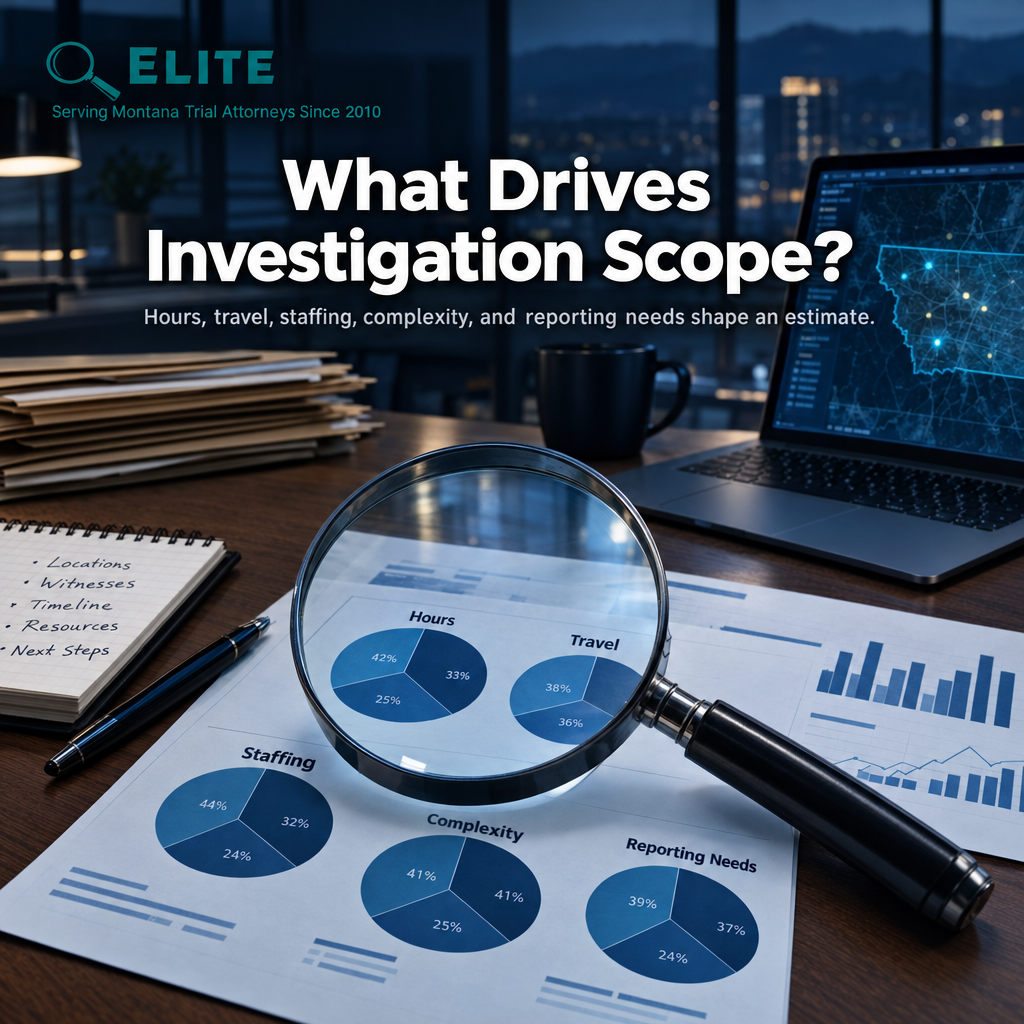
Surveillance investigation costs generally reflect the amount and difficulty of work required, rather than one standard price for every assignment. Expected surveillance hours, the number of days, travel between locations, distance from Billings or another service area, the number of subjects, schedule uncertainty, and reporting needs can all affect scope.
A clear objective can reduce wasted time because it helps an investigator select useful dates, locations, and observation windows. Before discussing an estimate, prepare these planning inputs:
- Objective: What activity or question requires documentation?
- Timing: When is the activity most likely to occur?
- Locations: Which known addresses or routes matter?
- Deliverable: What report, notes, photographs, or video format is needed?
Ask whether travel, additional hours, follow-up work, and written reporting are included in the proposed scope. It is also sensible to clarify how schedule changes, multiple locations, or limited visibility may affect the assignment. We recommend requesting a scope-based estimate after sharing the facts that shape the work.
Time, travel, staffing, and assignment complexity
Expected observation time is often the central scope issue, especially when the subject’s schedule is uncertain or activity may occur across several days. Travel from Billings to another Montana or Wyoming location, movement between sites, multiple subjects, and the need for more than one investigator can add complexity.
Reporting also requires time after observation ends. A concise investigative report, detailed chronology, photographs, video review, or follow-up questions may require different levels of work.
Questions to ask before approving an estimate
Ask what hours and dates are proposed, which locations are included, how travel is handled, and what happens if the subject does not appear. Confirm whether written reporting, photographs, video, follow-up communication, and additional observation require separate authorization.
You should also explain the intended audience for the report and any deadline. Those details help the investigator recommend a practical scope without promising that a particular event will be documented.
Which surveillance options fit the assignment?

The appropriate surveillance option depends on the question, visibility, traffic, expected activity, and whether the subject is likely to remain in one place or travel. Stationary observation may fit a known location, while mobile surveillance may be more appropriate when movement between locations matters.
Documentation should be practical and organized. Depending on the assignment, it may include contemporaneous notes, time and location records, photographs, video when appropriate, and a clear written report describing what was observed. These materials should reflect observable facts rather than conclusions that the evidence does not support.
Elite Investigations describes professional surveillance services that may involve GPS tracking and hidden cameras in certain personal investigations. Any technology must be used lawfully and within the assignment’s legal context. Before work begins, disclose known legal restrictions, protective orders, private-property concerns, safety risks, and evidence-handling requirements.
Stationary observation and mobile surveillance
Stationary observation focuses on activity at or near a relevant location, which can be useful when the question concerns arrivals, departures, visits, or conduct at that site. Mobile surveillance follows observable travel when the subject’s route or destinations are central to the assignment.
Visibility, traffic, distance, and safety affect which approach is practical. We recommend allowing the investigator to evaluate the known facts and choose an approach that matches the question.
Technology, documentation, and legal boundaries
GPS tracking and hidden cameras can raise legal, privacy, property, and evidence-handling concerns, so their use requires careful review before an assignment starts. We do not recommend assuming that a device or recording method is lawful simply because it is technically available.
Share protective orders, restricted locations, consent issues, and safety concerns at the consultation. The investigator can then discuss appropriate documentation methods and reporting expectations within the stated legal context.
Should you choose surveillance or another investigation service?
Choose surveillance when the missing information involves observable activity over time, but select another method when the question concerns records, identity, testimony, online activity, ownership, or incident conditions. Witness locating and interviews can seek firsthand accounts; background investigations can address history and identity; social media investigations can examine publicly available online activity; asset searches can address financial or property questions; and risk and liability investigations can examine incident-related facts.
A combined assignment may be more useful when surveillance documents activity but another method must establish identity, ownership, timeline, motive, or corroboration. No method should be treated as guaranteed to produce admissible or decisive evidence. The investigative plan should follow the question.
- State the unanswered question.
- Identify what evidence could answer it.
- Check whether the evidence is observable, interview-based, public-record, digital, or financial.
- Select surveillance alone or pair it with another service.
Match the method to the missing information
If you need to know where a person goes during a defined period, surveillance may fit. If you need a witness’s account, an interview may be more direct; if you need property or financial information, an asset search may be more relevant.
We recommend describing the missing information in plain terms before naming a service. That approach can prevent unnecessary observation and may produce a clearer investigative plan.
A practical method-selection checklist
Start by separating facts from assumptions, then identify the source that could independently address the issue. Consider whether the answer must come from observation, a person, a public record, online material, or financial research.
Next, consider whether one method can reasonably address the question or whether several methods should be coordinated. The final scope should account for legal restrictions, deadlines, reporting needs, and the intended use of the findings.
What should attorneys and individuals prepare before hiring an investigator?
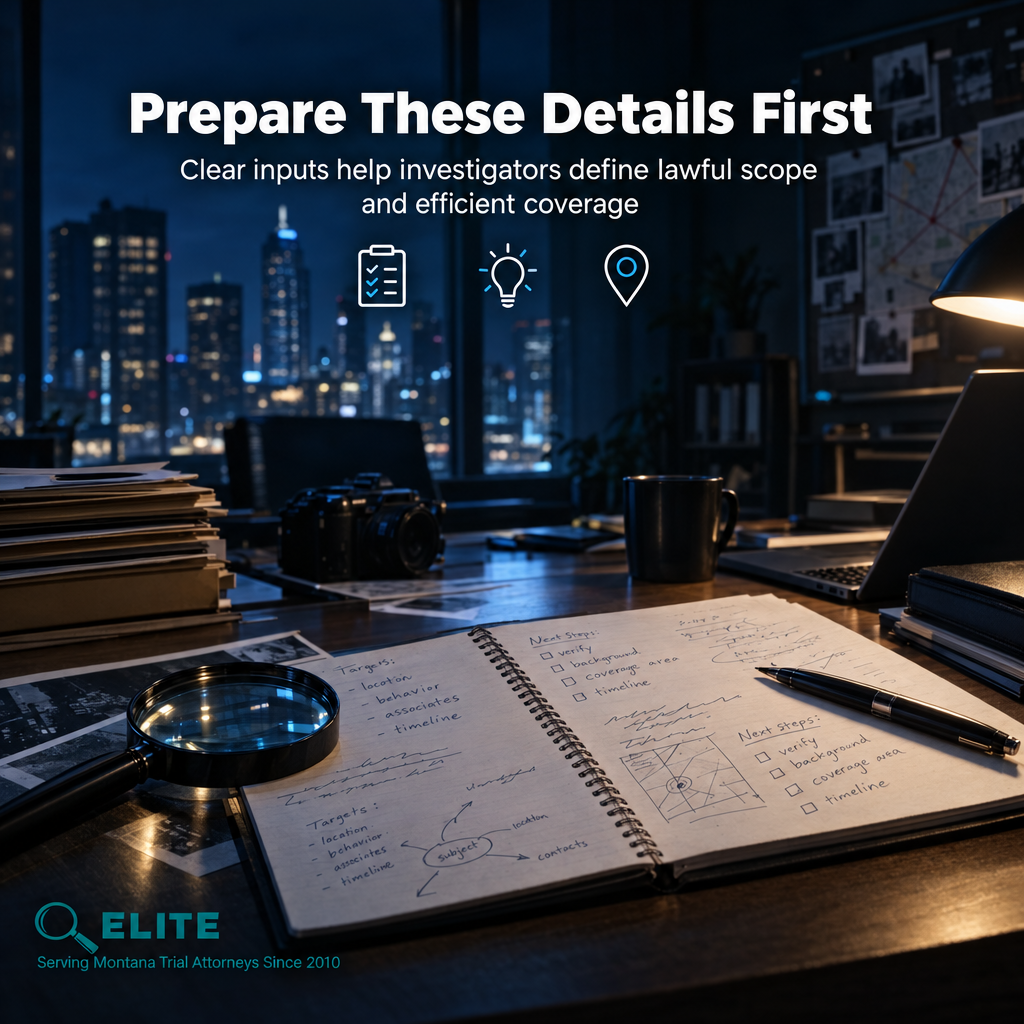
Prepare the subject’s identifying details, known vehicles, addresses, relevant dates, likely routines, case or personal objectives, and any information that could create a safety concern. These details help an investigator distinguish useful leads from general background and identify practical observation windows.
The legal context also matters. Tell the investigator the intended audience for the report, the deadline, the relevant jurisdiction, known restrictions, and any evidence-handling requirements before a method is recommended. Attorneys and law firms may have specific case objectives, while individuals may need help translating a personal concern into a lawful investigative question.
Avoid confronting, following, contacting, or attempting to monitor the subject yourself. Amateur actions can create safety risks, raise legal concerns, or compromise an investigation. Elite Investigations provides investigative support primarily to attorneys in Billings, Montana, surrounding areas, and Wyoming, and also works with individuals seeking private investigation services for complex matters.
Information that improves the initial consultation
A productive consultation usually begins with names, photographs when available, vehicle descriptions, addresses, dates, known schedules, and the specific question the assignment must address. Include relevant documents or timeline details that can help distinguish confirmed facts from unverified information.
Also explain the deadline, intended report recipient, jurisdiction, and whether another investigator or attorney is involved. These details help us discuss surveillance, legal investigations, or another appropriate service.
Privacy, safety, and legal precautions
Share protective orders, threats, sensitive locations, weapons concerns, and other safety information before work begins. The investigator needs this context to plan responsibly and avoid unnecessary risk.
Do not enter private property, install monitoring equipment, or contact the subject on your own behalf without appropriate legal guidance. We recommend allowing the professional team to review the assignment and its boundaries first.
When should you request professional surveillance support?
Request professional surveillance support when the matter depends on activity over time, the subject’s schedule is uncertain, independent documentation is needed, a deadline is approaching, or you cannot safely or reliably gather information yourself. These conditions often make informal observation incomplete or risky.
The first conversation should clarify the objective, locations, timing, known facts, alternative methods, likely scope, reporting expectations, and cost factors. Elite Investigations focuses on private investigation services, legal investigations, and surveillance support for attorneys and individuals, including matters involving Montana and Wyoming, without promising a particular outcome.
If you are unsure whether surveillance is appropriate, contact Elite Investigations at +14066988911 or info@elitepimt.com. We can discuss whether surveillance or another investigation service fits the question.
Signs that a consultation is appropriate
A consultation makes sense when you need independent documentation, cannot verify a subject’s routine, have conflicting accounts, or must preserve a clear timeline before a deadline. It is also appropriate when safety, distance, or legal boundaries make self-directed observation unsuitable.
Bring the unanswered question rather than assuming the answer must come from surveillance. We can discuss whether observation, interviews, background work, social media investigations, asset searches, or risk and liability investigations better fit the information gap.
What happens at the first conversation
The first conversation should review the people, locations, dates, objective, legal context, known restrictions, safety concerns, and intended use of the findings. We can then discuss likely scope, documentation, reporting, alternative services, and the factors that affect cost.
To begin, call +14066988911 or email info@elitepimt.com. You can also use our contact page to discuss the assignment with Elite Investigations.
Frequently Asked Questions
How much do surveillance investigations cost?
Pricing depends on expected hours, dates, travel, locations, staffing, assignment complexity, and reporting needs. Request a scope-based estimate after sharing the investigative objective, relevant details, deadlines, and intended deliverables.
What information should I provide before requesting surveillance?
Provide the subject’s identifying information, known vehicles and locations, relevant dates or routines, the question the investigation must address, legal context, deadlines, safety concerns, and intended use of the findings. These details help the investigator assess the appropriate method and scope.
Is surveillance the right service for every investigation?
No. Surveillance fits questions involving observable activity or movement over time, while witness interviews, background investigations, social media investigations, asset searches, or risk and liability investigations may better address other information gaps.
How do I get started with Elite Investigations?
Call +14066988911 or email info@elitepimt.com with the investigation question, relevant timing and locations, and any legal or safety considerations. We can discuss whether surveillance or another investigation service fits your needs.