Asset searches help attorneys identify property, business interests, ownership connections, and other potential collection leads before deciding how to pursue a claim, judgment, or related legal matter in Montana or Wyoming.
When does an attorney need an asset search in Montana or Wyoming?
An attorney usually needs an asset search when the legal team must understand what property, businesses, financial connections, or other recovery leads may exist before choosing its next step. A search can help counsel organize facts for civil litigation, judgment enforcement, due diligence, divorce-related investigations, or disputes involving ownership.
The assignment should begin with a defined question. For example, counsel may need to determine whether a subject appears connected to real property, a registered business, a former address, or an entity that may matter to the case. A focused purpose helps us distinguish useful leads from unrelated records and keeps the geographic scope manageable.
Asset searches do not replace legal advice or attorney-directed discovery. They support case planning by giving the legal team documented information and investigative leads to evaluate. Elite Investigations provides professional investigative services to attorneys in Billings, surrounding Montana communities, and Wyoming.
A clear objective also helps identify whether an asset search is the right service or whether the assignment may call for a bank account search, background investigation, witness work, or another legal investigation.
What information should you provide before requesting an asset search?
The most useful intake includes accurate identity details, location history, business connections, case purpose, relevant documents, and a defined Montana or Wyoming geographic scope. Attorneys should share only information they can lawfully provide and should identify any filing deadline, hearing, collection step, or other date that affects the assignment.
- Legal identity: Provide the subject’s full legal name, known aliases, former names, date of birth when lawfully available, and identifying details that distinguish the person from others with similar names.
- Known locations: List current and former addresses, mailing addresses, post-office addresses, seasonal residences, workplaces, and locations connected to the case.
- Business connections: Include business names, registered entities, employers, partners, contractors, vendors, and known ownership relationships.
- Case purpose: Explain whether the assignment concerns civil litigation, judgment enforcement, due diligence, disputed ownership, divorce-related investigation, or another defined question.
- Relevant documents: Share pleadings, judgments, discovery, property references, correspondence, prior research, and records that may help establish identity or ownership.
- Geographic scope: Identify counties, cities, Montana communities, Wyoming jurisdictions, and prior locations that should be reviewed or excluded.
Incomplete or outdated information can create duplicate records, missed connections, and leads that require additional verification. A short written intake summary gives the investigator a practical starting point and makes it easier to identify missing details before work begins.
Identity details that reduce false matches
Full legal names, aliases, former names, known employers, location history, and lawfully available birth information reduce the risk of confusing one person with another. Attorneys should flag spelling variations and similar names, especially when records span multiple counties or states.
Known associates can also help separate matching records from unrelated ones. We recommend identifying information that can be verified through lawful records rather than relying on assumptions about a subject’s identity.
Documents and geographic boundaries
Useful documents may include pleadings, judgments, addresses, business names, property references, prior discovery, and relevant correspondence. These materials help connect the search to the legal question instead of producing a broad collection of unrelated records.
A defined county list or Montana and Wyoming location history helps us prioritize research. Attorneys should also identify locations that are leads only and require verification.
Which investigative methods can an asset search include?

An asset search may include public-record research, property checks, business-record review, corporate connection research, and cross-referencing known addresses and associates. The exact methods depend on the assignment, the information supplied, the jurisdictions involved, and the records lawfully available.
Public property records may help identify apparent ownership interests or transfers for further review. Business registrations can show entity names, registered agents, filing histories, or connections that warrant additional investigation. Researchers may compare those records with known addresses, employers, associates, and case documents to identify consistent patterns or discrepancies.
When relevant to the subject’s history, an investigator may compare records across Montana counties and Wyoming jurisdictions, including areas connected to Billings, Bozeman, Butte, Anaconda, Baker, or Missoula County. That does not mean every location must be searched. The legal purpose should determine which places deserve attention.
An asset search differs from a bank account search. Bank account information and other protected financial records may require formal legal process, authorization, or attorney-directed discovery. Lawful investigative work can support case planning, but no responsible search should promise access to every account, transfer, asset, or hidden interest.
How are Montana and Wyoming location factors handled during the search?
Montana and Wyoming searches require jurisdiction-specific planning because property systems, business registrations, court records, rural addresses, ownership filings, and cross-border activity can vary by county or state. A name that appears in one record may require comparison with other filings before counsel can determine whether it relates to the subject.
Before setting the scope, attorneys should identify ties to Billings, Bozeman, Butte, Missoula County, eastern Montana, or a Wyoming community. Seasonal residences, ranch or agricultural interests, registered businesses, post-office addresses, and prior locations can all serve as leads, but each requires verification.
Rural properties and changing ownership records may create practical research questions about the correct county, entity, mailing address, or historical filing. Cross-border activity can also require separate searches rather than assuming one state’s records answer the question.
We recommend confirming the relevant Montana or Wyoming jurisdiction and the lawful records available before work begins. That step helps align the assignment with the attorney’s purpose and avoids promising a scope that the available records cannot support.
What should an attorney expect in the asset-search results?
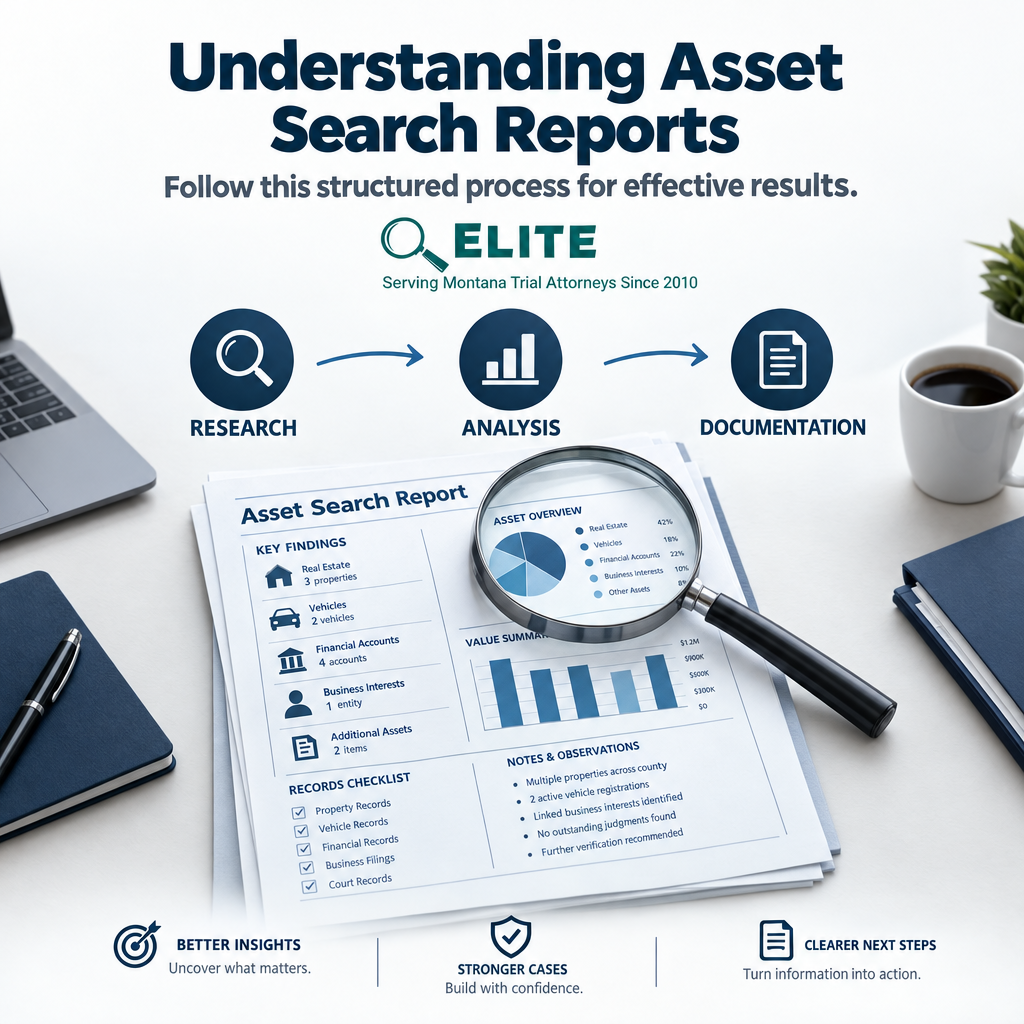
Attorneys should expect an organized report or communication covering the agreed scope, documented records, possible leads, unresolved discrepancies, and items that may require additional verification. Timing can vary with the number of jurisdictions, record availability, name confusion, outdated filings, and whether assets appear connected to other people or entities.
Before the search starts, counsel and the investigator should agree on deliverables, communication points, geographic limits, and any relevant deadline. They should also identify whether the assignment calls for initial leads, record confirmation, follow-up research, or information that may support attorney-directed discovery.
Our role at Elite Investigations is to support attorneys with professional investigative services while keeping expectations grounded in the assignment and available records. We do not present an asset search as a guaranteed inventory of everything a person may own or control.
Leads, records, and verification
Results may include public property records, business relationships, address connections, apparent ownership interests, and questions for further investigation. Each apparent match should be checked against identity details, dates, locations, and related records before counsel relies on it.
We recommend separating confirmed records, reasonable leads, unresolved discrepancies, and items requiring formal legal process. This structure makes the findings easier for a legal team to review and act upon.
Using findings in legal strategy
Organized findings can help counsel decide whether to pursue additional discovery, records requests, interviews, surveillance, or collection steps. The investigator’s work supports those decisions without determining the legal strategy for the attorney.
A useful report should show what was reviewed, what remains uncertain, and which questions may require authorization or court-directed process. That distinction helps preserve accuracy when the legal team evaluates its next move.
How can a Montana or Wyoming law firm start an asset search with Elite Investigations?
Start by contacting Elite Investigations with the subject’s identity, the case purpose, relevant locations, available documents, timing needs, and desired search scope. Our team serves attorneys in Billings and surrounding Montana areas, including Wyoming, and can discuss whether an asset search, bank account search, background investigation, or another service fits the assignment.
Before the consultation, prepare a concise written intake summary. Include the question counsel needs answered, known aliases and addresses, business connections, relevant counties or cities, documents available for review, and any deadline. This gives us a clearer basis for identifying missing information and likely research boundaries.
Elite Investigations focuses on professional investigative support for attorneys and clients in Montana and surrounding areas. The firm’s stated responsiveness is part of its attorney-support approach, while the specific scope, timing, and deliverables should be discussed for each assignment.
Contact Elite Investigations to discuss an asset-search assignment involving Billings, another Montana location, or Wyoming.
Frequently Asked Questions
What does an asset search for an attorney typically examine?
An asset search may examine publicly available property records, business registrations, ownership connections, addresses, and related records within an agreed scope. The methods depend on the assignment, the jurisdictions involved, and lawful access to information.
The search may identify records and leads for counsel to evaluate. It should not be described as a guaranteed inventory of every asset, account, transfer, or financial interest.
What should I send a private investigator before requesting an asset search?
Send the subject’s legal name, aliases, former names, known addresses, location history, business connections, relevant case documents, and the legal or investigative purpose. Include a defined Montana or Wyoming geography and any deadline affecting the assignment.
Only provide information you can lawfully share. Clear identity details and documents help reduce false matches and focus the research on records that relate to the case.
Can an asset search find every bank account or hidden asset?
No lawful search should be presented as a guaranteed inventory of every bank account, hidden asset, transfer, or ownership interest. Bank account information and other protected records may require formal legal process, authorization, or attorney-directed discovery.
An asset search can still identify public records, business connections, property leads, and questions for further investigation. Counsel can then decide whether additional legal procedures are appropriate.
Does Elite Investigations serve attorneys in Billings and Wyoming?
Yes. Elite Investigations provides investigative services to attorneys in Billings, Montana, surrounding areas, and Wyoming.
Discuss the specific county, city, subject information, and assignment purpose with the firm so the geographic scope and appropriate investigative method can be clarified.
How do I begin an asset search for a Montana or Wyoming case?
Contact Elite Investigations through its website with the subject information, case purpose, locations, available documents, desired scope, and deadline. A consultation can help establish practical boundaries and determine whether an asset search or another investigative service fits the matter.
Preparing a concise intake summary beforehand can make that first discussion more productive. It also helps identify missing details before research begins.