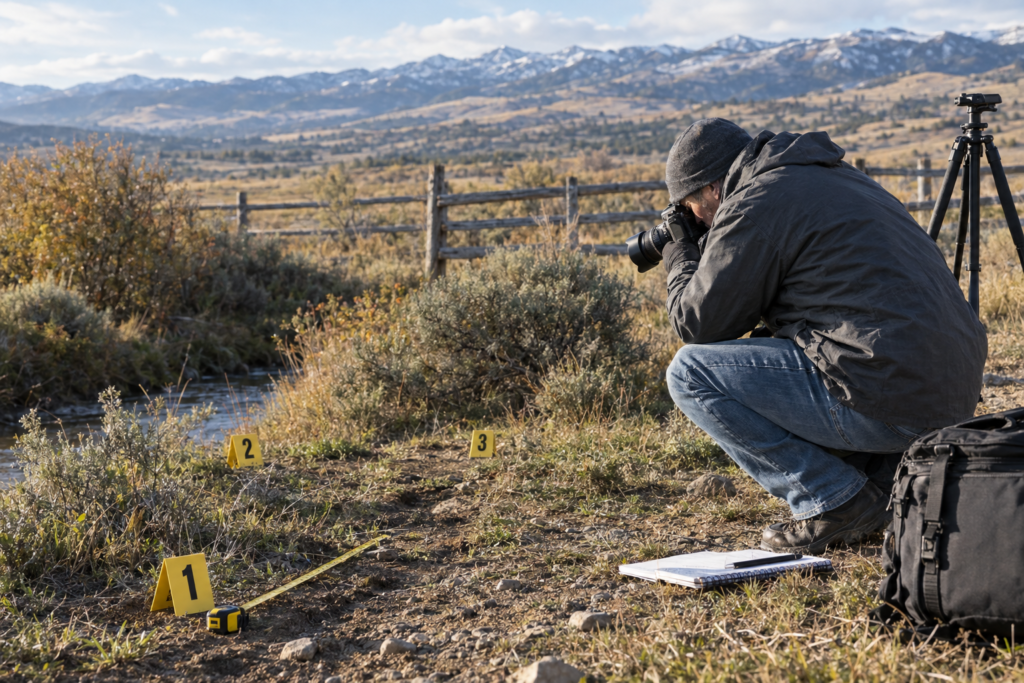
Private investigators help attorneys, law firms, and individuals answer unresolved legal questions through lawful fact-finding across Montana and Wyoming, while public officers and emergency services handle immediate danger, crimes in progress, and police powers. We help define the assignment, locate people, document observable activity, review public information, and organize findings for attorney or client review.
When should you contact a private investigator for a legal or criminal matter?
Contact a private investigator when a legal issue cannot wait, key facts remain unclear, a witness is difficult to locate, or available records do not answer the central question. A focused investigation can turn a broad concern into a defined assignment with known people, places, dates, and desired findings.
Recognizing an investigation gap
An investigation gap exists when you know what decision must be made but lack reliable facts to support it. Witness locating and interviews, background checks, asset searches, surveillance investigations, or social media investigations may address different gaps, so we recommend identifying the precise question before requesting a service. Attorneys should also consider how the findings may fit discovery, motion practice, negotiation, or trial preparation.
Separating urgent safety issues from investigative support
Immediate danger, a crime in progress, or an emergency threat requires law enforcement or emergency services, not a private investigator. A public officer, such as a police officer, may exercise public authority that a private investigator does not possess. We provide lawful investigative support after or apart from the emergency response, and we do not replace public officers or emergency responders.
Before the first conversation, write down the central question, known facts, relevant people or locations, and deadline affecting the matter. This preparation helps an investigator assess whether the assignment is appropriate and what information may be needed next.
What should you prepare before requesting an investigation in Montana or Wyoming?
Prepare a concise case summary, supporting records, known identifying information, and every deadline that could affect the work. Elite Investigations provides professional investigation services primarily to attorneys in Billings, Montana, surrounding areas, and Wyoming, so location and timing should be discussed at the outset.
The assignment facts and desired outcome
State the case type, the question to answer, the people involved, and the decision the findings will support. Explain whether the matter involves legal investigations, a civil investigation, a criminal investigation, a family concern, or another defined need. A clear desired outcome helps separate useful investigative work from information that may be interesting but irrelevant to the case.
Documents, names, dates, and deadlines
Gather full names, aliases, addresses, phone numbers, dates, relevant documents, photographs, account information, and records of prior investigative steps. Attorneys should identify court dates, filing deadlines, discovery requirements, and hearing dates before work begins. These details help the investigator prioritize tasks and communicate whether the requested timing is realistic.
Location and jurisdiction questions
Identify every relevant location, including Billings, Anaconda, Baker, Bozeman, Butte, Missoula County, or a Wyoming community when applicable. Montana and Wyoming assignments may involve different locations, records, travel needs, and legal questions. We recommend confirming the specific service area and coordinating jurisdiction questions with counsel before authorization.
What to bring to the initial investigator call:
- Define the central question and the decision the findings should support.
- Organize records, names, aliases, addresses, phone numbers, dates, and prior investigative results.
- Identify targets, witnesses, relevant properties, accounts, platforms, or locations.
- State court dates, filing deadlines, discovery requirements, and other timing constraints.
- Confirm the Montana or Wyoming service area and ask whether the requested assignment fits the investigator’s capabilities.
Which investigative services can support a legal case?
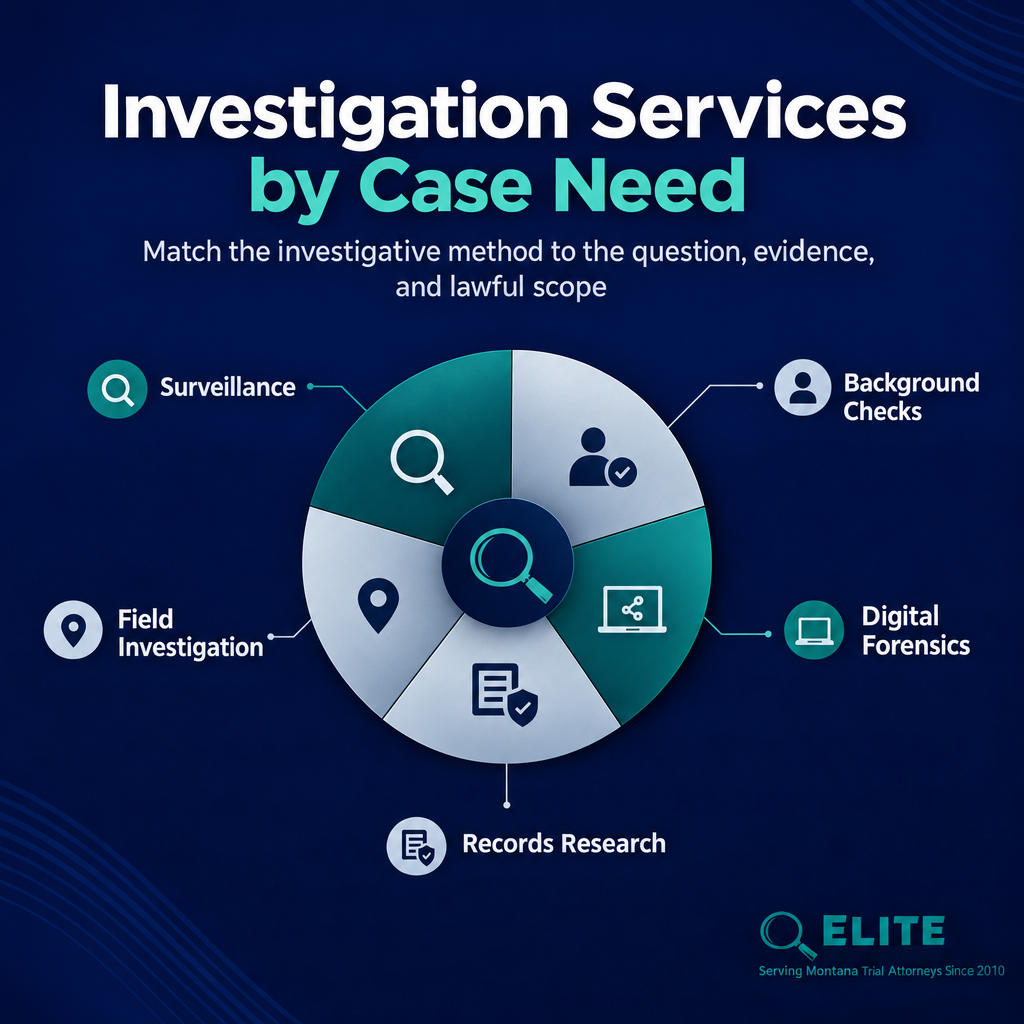
Legal cases may benefit from different investigative services depending on the question, available evidence, and lawful scope. Elite Investigations offers legal investigations, civil and criminal investigations, witness locating and interviews, surveillance investigations, asset searches, bank account searches, background checks, and social media investigations as distinct service categories.
Finding and evaluating people
Witness locating can help identify people who may have relevant knowledge, while interviews can preserve leads for attorney review when conducted lawfully and with appropriate permissions. Background checks may organize available information about a person, but the requested scope and permitted use should be clear. We recommend giving counsel the opportunity to assess privacy, relevance, and admissibility before relying on results.
Documenting activity and public information
Surveillance documents observable activity when a case requires evidence about patterns, conduct, or location, but no assignment can promise a particular result. Asset searches, bank account searches, and social media investigations address different information sources and limitations. Public information may be incomplete, and access to private or protected records cannot be assumed.
Supporting civil and criminal matters
Private investigators can support civil and criminal matters by organizing facts for attorneys, law firms, and individuals, while the attorney remains responsible for legal strategy. Discuss admissibility, privacy, jurisdiction, chain of custody, and lawful methods with counsel. Our team focuses on the investigative question and the agreed scope rather than making legal conclusions for the client.
How should you scope a social media investigation before authorizing it?
Define the subject, usernames or aliases, platforms, date range, locations, and precise question before authorizing a social media investigation. A clear scope also makes it easier to discuss what information will be delivered, how findings will be organized, and what the assignment may cost.
Defining platforms, people, and time periods
List the person or organization to be researched, known usernames, likely aliases, relevant platforms, locations, and the dates that matter. Explain whether the question concerns identity, contact, timing, location, public statements, or another case issue. A narrow question usually produces a more useful assignment than an open-ended request to search everything.
Confirming lawful access and expected deliverables
Ask whether the work will rely on publicly available information and how the investigator will document dates and sources. Public information may be incomplete, accounts may be private, content may change, and relevant material may not exist. Before authorization, confirm whether the deliverable includes written findings, screenshots, links, source notes, or another agreed format.
Discussing cost before work begins
The cost of a social media search depends on the number of subjects and platforms, time period, search scope, documentation requested, and reporting needs. We recommend requesting a defined estimate before authorization rather than relying on an invented flat rate. Ask what would cause the scope or cost to change and how additional work will be approved.
For attorneys, social media findings should be reviewed with litigation strategy and evidence rules in mind. Individuals should also understand that a private investigator cannot promise access to private accounts, deleted material, or protected records.
What should you ask about communication, records, and investigative costs?

Before work begins, confirm the investigator’s role, assignment scope, estimated timeline, billing structure, possible expenses, and process for approving work outside the original request. Clear communication protects the usefulness of the investigation and helps attorneys coordinate findings with case strategy.
Setting the communication plan
Agree on when progress updates will arrive, who should receive them, and how urgent developments will be communicated. Ask what happens if the investigation produces no usable lead or if a witness cannot be located. Individuals should identify one primary contact, while law firms should clarify whether updates go to counsel, a case team, or another authorized person.
Clarifying fees and expenses
Ask how investigative time is billed, which expenses may arise, and whether travel, records, interviews, surveillance, or reporting require separate approval. The exact cost depends on the assignment, so the scope and estimate should be discussed directly with Elite Investigations. Written confirmation of authorized work can reduce misunderstandings when the facts change.
Reviewing updates and final materials
Depending on the assignment, final materials may include written findings, organized records, interview notes, photographs, or other agreed documentation. Confirm the format before work starts and ask how dates, sources, and observations will be identified. Attorneys should evaluate the materials under applicable evidence rules, while individuals should understand what the investigator can and cannot legally obtain.
Readers who want more context about timing can review our guidance on when attorneys should bring a private investigator into a case.
How do you start with Elite Investigations across Montana and Wyoming?
Start by contacting Elite Investigations through its website or by phone, then explain the legal or investigative question, relevant Montana or Wyoming location, and deadline. Our team provides professional investigation services primarily to attorneys in Billings, Montana, surrounding areas, and Wyoming, while each assignment and location should be confirmed during the initial discussion.
Requesting an initial discussion
Bring the central question, known facts, relevant documents, names, locations, and timing constraints to the initial conversation. Ask whether the requested work fits the firm’s capabilities, including legal investigations, witness interviews, surveillance, asset searches, background checks, and social media investigations. This discussion gives both sides a practical basis for defining the assignment.
Confirming fit and next steps
Confirm the service area, lawful scope, communication plan, expected deliverables, estimated timeline, fees, and approval process before work begins. Attorneys, law firms, and individuals can contact Elite Investigations at +1-406-698-8911 or through the firm’s website to discuss the matter. Our team can then explain the next step based on the information provided, without implying that every assignment is automatically accepted.
Frequently Asked Questions
Does Elite Investigations serve Billings, Montana, surrounding areas, and Wyoming?
Yes, Elite Investigations provides professional investigation services primarily to attorneys in Billings, Montana, surrounding areas, and Wyoming. Confirm the specific location, assignment, and timing during the initial contact because coverage and fit depend on the details.
How do I get started with a private investigator for a legal matter?
Gather the central question, known facts, relevant documents, locations, names, and deadline, then contact Elite Investigations by phone or website. Discuss fit, service area, scope, communication, deliverables, and next steps before authorizing work.
Can a private investigator handle a criminal emergency?
Immediate danger, a crime in progress, or another emergency requires law enforcement or emergency services. A private investigator may provide lawful investigative support for an attorney or client after the immediate emergency is addressed, but does not replace a public officer or exercise police powers.