Public records research can confirm a documented fact, but it may not answer who a person is, where they are now, what they have done, or which evidence matters to a legal or business decision. We help attorneys, law firms, and individuals in Billings, Montana, Wyoming, and surrounding areas decide when an online search is enough and when professional investigation is the more reliable next step.
When does a public records search stop answering the real question?
A public records search stops being sufficient when the question depends on identity, current conduct, personal contact, conflicting information, or follow-up beyond an accessible database. Attorneys, businesses, and individuals should first ask whether they need one clearly defined fact or a tested understanding of what happened.
What public records can establish
Public records can help confirm property ownership, court filings, business registrations, professional licenses, and other documented facts. They can provide a useful starting point for due diligence, background research, or a legal investigation, although no single record system should be assumed complete, current, or identical across jurisdictions.
Where online research begins to break down
Online research becomes less dependable when a subject uses alternate names, records are incomplete, addresses are outdated, dates conflict, information is sealed, or relevant records sit in multiple jurisdictions. Search results may suggest a lead without establishing identity, intent, current location, relationships, or conduct, which is why human interpretation and verification matter.
How do public records research and professional investigation differ?
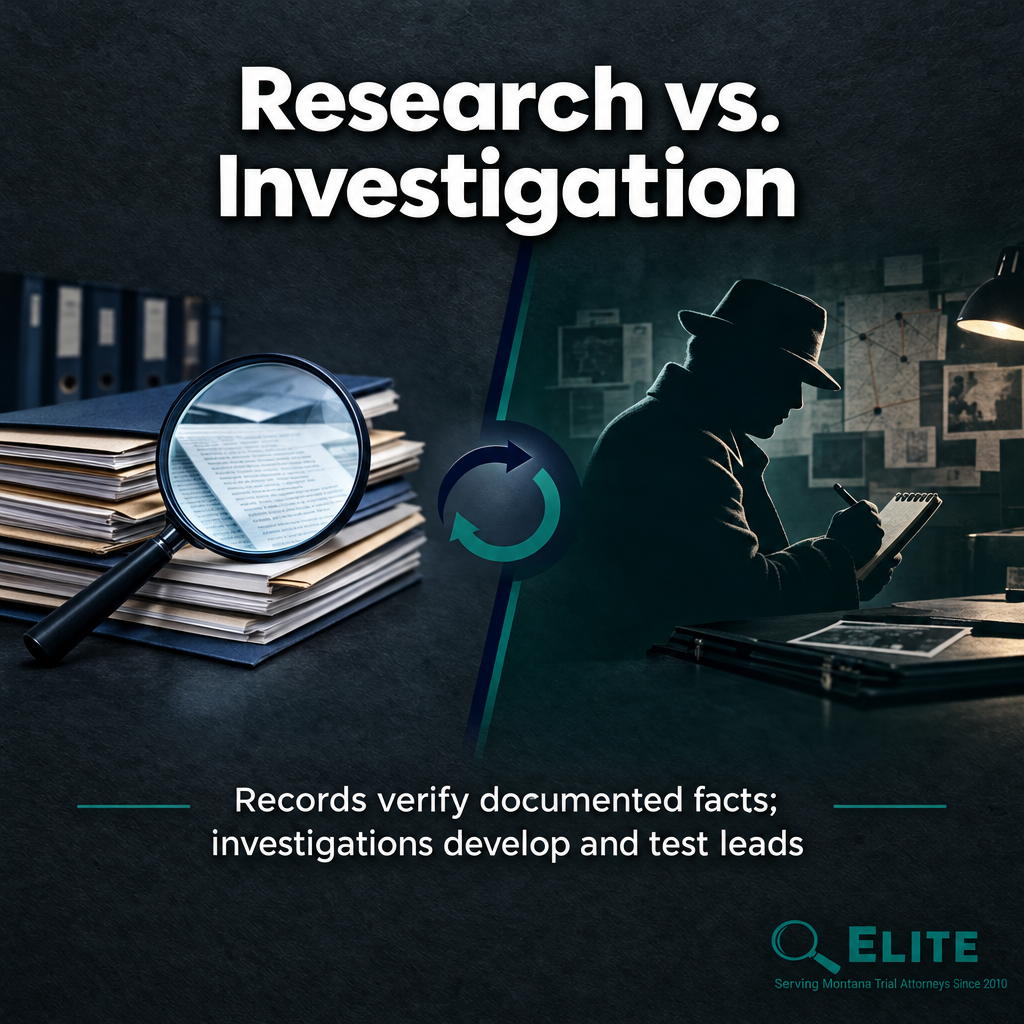
Public records research verifies information found in lawful, accessible sources, while professional investigation develops and tests information across records, people, and field-based methods. Self-directed research may be faster and appropriate for a narrow question, but professional support adds planning, source evaluation, follow-up, documentation, and judgment when the stakes are higher.
- Primary purpose: Public records research verifies documented facts; professional investigation develops and tests information across multiple sources.
- Typical sources: Public databases and filings versus records, interviews, social media research, surveillance, and other lawful investigative methods.
- Human judgment: Self-directed searches depend on the reader’s ability to identify and interpret records; investigators assess leads, inconsistencies, and relevance.
- Best fit: Simple, defined questions versus matters involving missing witnesses, disputed facts, safety concerns, assets, or legal strategy.
Purpose, sources, and verification
The purpose of public records research is usually to locate and understand a specific documented fact. A professional investigation may begin with those same records, then compare names, dates, addresses, and filings with other lawful sources to test whether the information is relevant and connected to the right person or entity.
Desk research compared with interviews and fieldwork
Professional investigation does not simply mean searching more websites. It can include witness locating and interviews, surveillance where lawful, social media investigations, asset searches, and organized reporting, while desk research may remain the right choice for a low-risk document question. The added cost of professional help is most justified when missed context could affect a case or major decision.
Which questions require professional investigative support?
Professional support is appropriate when a question is open-ended, disputed, cross-jurisdictional, time-sensitive, or dependent on people who must be found and contacted. Escalation makes sense when a subject uses multiple names, information spans Montana and Wyoming, records conflict, a witness cannot be reached, or an attorney needs findings organized for a legal decision.
Signals that the matter has become complex
A matter has become complex when the available records point in different directions or fail to answer the central question. Unreachable witnesses, uncertain identities, current-location questions, and evidence that may influence civil or criminal proceedings all require careful scope definition, lawful methods, and documentation rather than casual online searching.
Services that address different investigative needs
Witness locating and interviews address people-based information, while surveillance can document observations where lawful. Asset searches and bank account searches may develop financial leads; background checks and social media investigations can add context. Nursing home investigations, civil and criminal investigations, corporate investigations, risk and liability investigations, due diligence, and contractor or vendor vetting each require a defined assignment.
Readers should never access restricted accounts, impersonate another person, trespass, or collect information unlawfully. A professional should explain the available methods, practical limits, and legal boundaries before work begins.
How should you choose between self-directed research and an investigator?
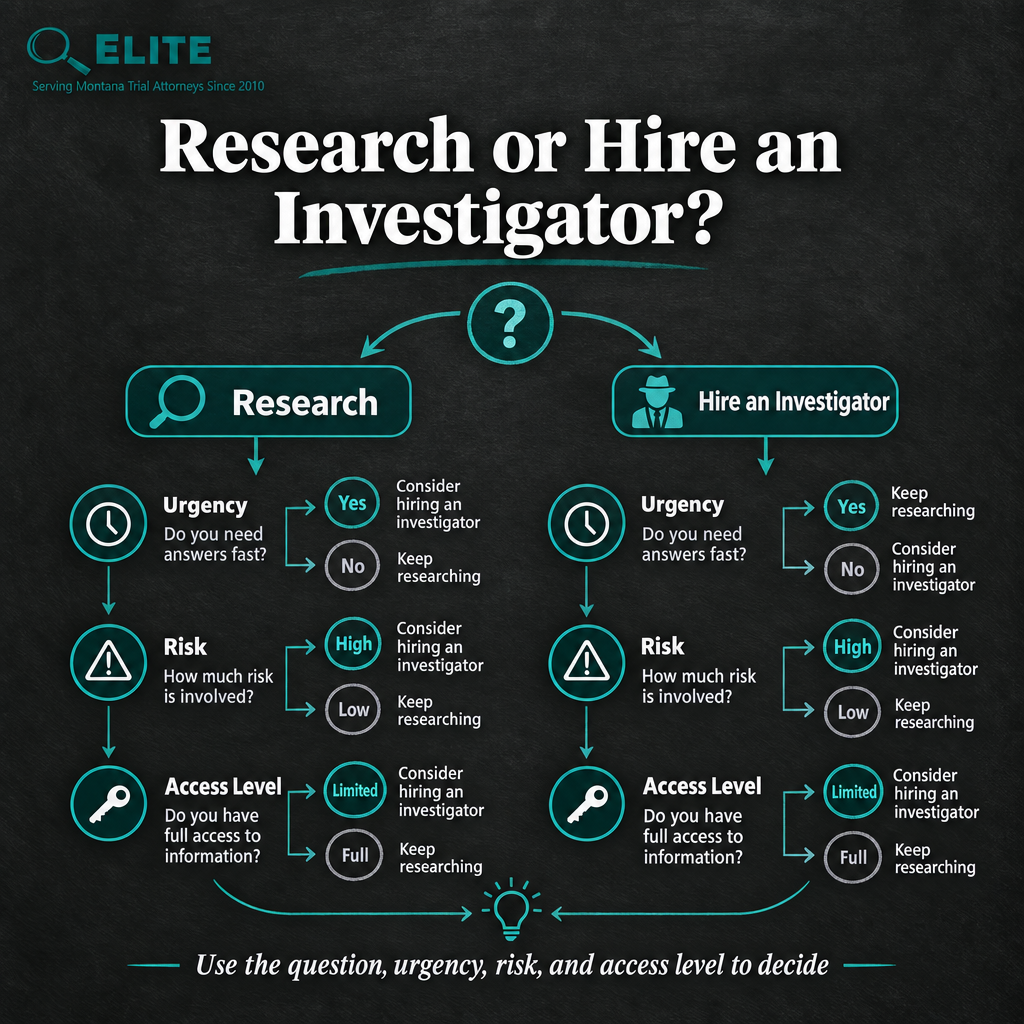
Choose public records research when the fact is specific, documented, accessible, and low-risk; seek an investigator when the question is open-ended, urgent, disputed, cross-jurisdictional, or dependent on interviews and follow-up. The decision should reflect the consequences of an incomplete answer, not only the convenience of an online search.
A practical decision framework
Start by writing the exact fact you need to establish and identifying the record that might contain it. If the answer should appear in one accessible filing, self-directed research may be reasonable. If the answer requires connecting people, testing conflicting accounts, locating a witness, or organizing evidence for counsel, professional investigation is the more suitable path.
Questions to ask before authorizing work
Ask about service area, relevant investigative experience, lawful methods, expected deliverables, communication, scope changes, and how findings will be presented. Attorneys should explain the case objective, known names and locations, deadlines, and evidentiary needs. Individuals should share only information needed to define the inquiry and ask how sensitive materials will be handled.
Elite Investigations provides professional investigative services for attorneys and individuals in Billings, Montana, Wyoming, and surrounding areas. Our team can help clarify whether the matter calls for public records research, broader online private investigation services, or investigative work beyond the computer.
What should you prepare before contacting a private investigator?
Prepare the precise question, names and aliases, known addresses, relevant dates, jurisdictions, documents already found, desired deadline, and the decision the findings will support. Separating confirmed facts from assumptions helps an investigator test leads instead of treating speculation as evidence.
Information that improves the initial assessment
Bring the records you have already reviewed and identify where each item came from, when it was obtained, and what it appears to establish. Mark uncertain details clearly, including possible aliases, approximate dates, and unverified addresses. A records summary, witness-location update, interview report, surveillance documentation, or organized investigative findings may be appropriate depending on the assignment.
How the investigation can be scoped clearly
A clear scope connects the question, jurisdiction, timeline, lawful methods, communication expectations, and desired output. Before authorizing work, explain what decision the findings will support and which facts are outside the assignment. To discuss whether professional support fits, contact Elite Investigations with the information available.
What should you expect from the first conversation with Elite Investigations?
The first conversation should turn a broad concern into a defined objective, practical methods, reporting plan, and realistic limits. We review the known information, locations, timing, legal or business context, possible investigative approaches, and the type of findings the client needs.
Turning a broad concern into an investigative scope
Elite Investigations is a Billings-based resource serving Montana, Wyoming, and surrounding areas for attorneys, law firms, and individuals. Depending on the question, the discussion may involve legal investigations, surveillance investigations, asset searches, witness locating and interviews, background checks, social media investigations, nursing home investigations, or civil and criminal investigations.
When professional support is the sensible next step
Professional support is sensible when online research has produced leads but not a dependable answer, especially where identities, witnesses, locations, or conflicting records remain unresolved. Readers who have reached that limit can contact our team to discuss the question, location, urgency, and type of support needed before deciding how to proceed.
Frequently Asked Questions
Is public records research the same as a professional investigation?
No. Public records research focuses on documented information available through lawful, accessible sources, while professional investigation may combine records with source evaluation, interviews, surveillance, social media research, asset searches, and follow-up. The appropriate choice depends on the question’s complexity and stakes.
When should I use online searches instead of hiring a private investigator?
Use online searches for a narrow, low-risk question involving a specific public document or clearly defined fact. Seek professional support when records conflict, identities are uncertain, multiple jurisdictions are involved, witnesses must be located, or findings will support a legal or major business decision.
Can online private investigation services include social media searches?
Yes, social media research can be one part of a broader lawful investigation. The scope may include reviewing publicly accessible information, identifying relevant accounts or activity, organizing findings, and connecting online leads with other investigative questions, without promising access to private accounts or guaranteed results.
Do Elite Investigations services cover Billings, Montana, and Wyoming?
Elite Investigations serves Billings, Montana, Wyoming, and surrounding areas. Confirm that the requested assignment and specific location fit the firm’s service area during the initial conversation.
How do I get started with professional investigative support?
Prepare the core question, names, dates, locations, records already reviewed, deadline, and desired outcome. Then contact Elite Investigations through its website or business contact information to discuss scope, lawful methods, reporting needs, and next steps.