Attorneys can have pleadings, reports, records, and testimony yet still lack a verified timeline, reachable witnesses, confirmed identities, or facts explaining a person’s conduct. A focused legal investigation helps identify those evidence gaps and turns unresolved questions into a lawful, documented investigative plan.
Why a complete-looking case file can still contain evidence gaps
A complete-looking case file may still fail to answer the factual questions that drive settlement, motion practice, trial preparation, or a criminal investigation. The file may contain substantial material while leaving the timeline dependent on assumptions, a witness’s address unverified, or a person’s identity insufficiently confirmed.
We recommend an evidence-gap review before requesting a broad, undefined search. The attorney and investigator can identify what the file establishes, what it merely alleges, and what still needs independent verification. That review may reveal conflicting statements, unexplained time periods, missing records, inconsistent addresses, or conduct that has not been tested against other evidence.
The purpose is to test what the file supports without prejudging the outcome. A legal investigator should receive a factual question and relevant boundaries, not instructions to find a preferred conclusion. This approach helps preserve professional judgment and gives the legal team a clearer basis for deciding whether to pursue witness interviews, records research, surveillance, digital review, or another method.
Warning signs in witness accounts and contact information
Conflicting dates, changing descriptions, incomplete contact details, and repeated reliance on secondhand information are direct warning signs that witness evidence needs review. We also look closely at addresses that came from an old report, phone numbers with no source, aliases that have not been matched to a known identity, and statements that describe events without a clear time or location. These gaps do not prove unreliability, but they identify questions that should be resolved before the evidence carries significant strategic weight.
How missing facts can affect case strategy
Missing facts can affect whether counsel can confirm a timeline, challenge an account, locate corroboration, or evaluate the strength of a claim. An unreachable witness may hold information that changes the order of events, while an unverified assumption may cause the legal team to spend time on the wrong issue. A focused investigation helps distinguish a genuine evidentiary weakness from a question the existing file already answers.
How to audit witness evidence before requesting investigative help
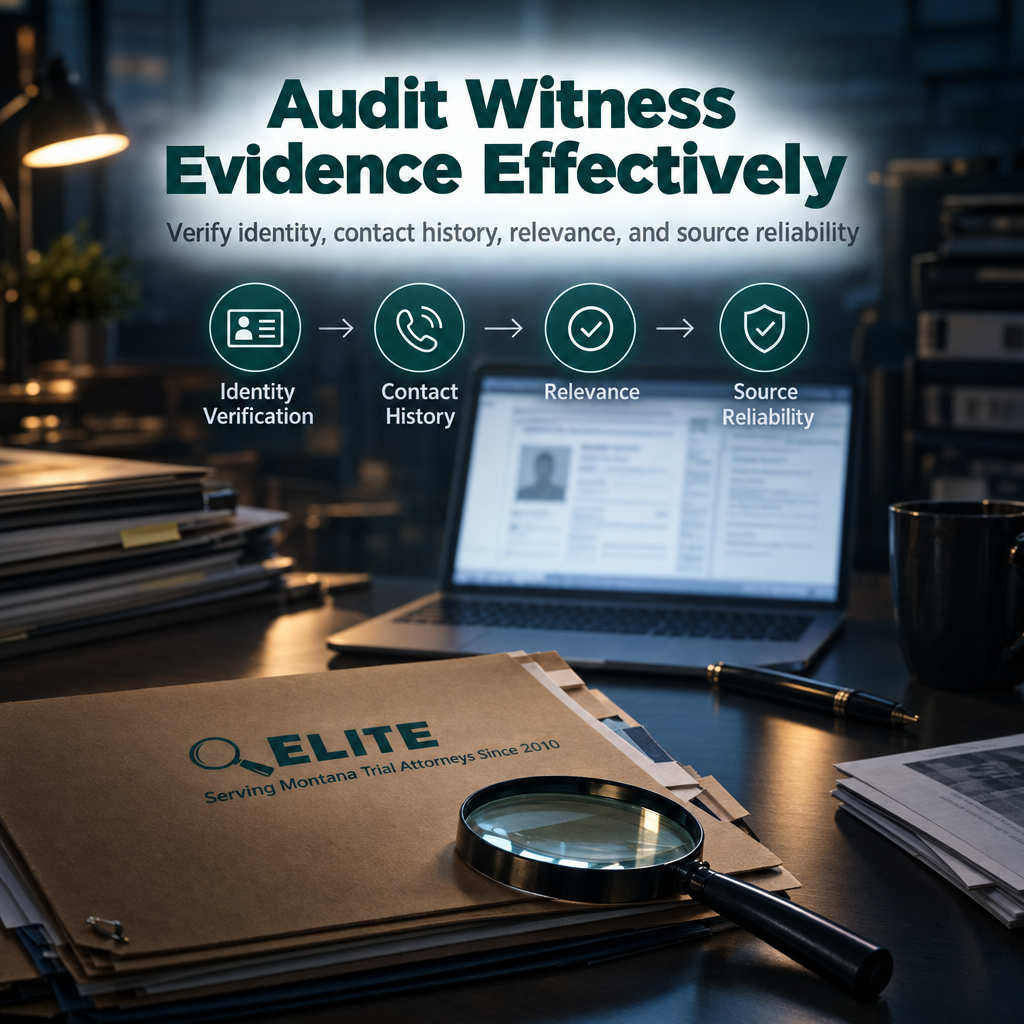
A witness audit should begin with full names, aliases, last known addresses, employers, phone numbers, relationship to the matter, and the source of every contact detail. We recommend noting whether each person has firsthand knowledge, what documents mention them, and when the legal team last confirmed their information.
A legal investigator may help locate hard-to-reach witnesses, conduct professional interviews, compare accounts, and identify additional people named in existing statements. Before that work begins, attorneys can organize the file around five checks:
- Identity: Verify that records and statements refer to the same person.
- Reachability: Identify current contact routes and likely barriers.
- Knowledge: Separate firsthand observations from hearsay.
- Consistency: Compare dates, locations, sequence, and wording across accounts.
- Priority: Rank witnesses by relevance, availability, and risk of lost recollection.
Interviews should remain lawful, professional, and accurately documented. The investigator should preserve the witness’s own words, record only when permitted, avoid pressure or coaching, and note when an answer reflects uncertainty. Those safeguards help the attorney assess the information rather than inherit an interview shaped by assumptions.
Confirming identity, location, and availability
Identity, current location, and availability should be verified before an attorney treats a witness as a dependable investigative lead. A legal investigator can compare identifiers, review lawful sources, and determine whether an old address or employer still offers a realistic contact route. The assignment should also note known restrictions, safety concerns, or requested communication boundaries so outreach remains appropriate and does not compromise the matter.
Prioritizing interviews and documenting discrepancies
Interview priority should reflect expected relevance, access, urgency, and the possibility that recollection or digital information may change. We recommend documenting each discrepancy by source, date, subject, and materiality instead of labeling a witness generally as credible or unreliable. That format lets counsel decide whether the difference requires another interview, supporting records, or a revised case timeline.
Which digital and social media gaps deserve closer review
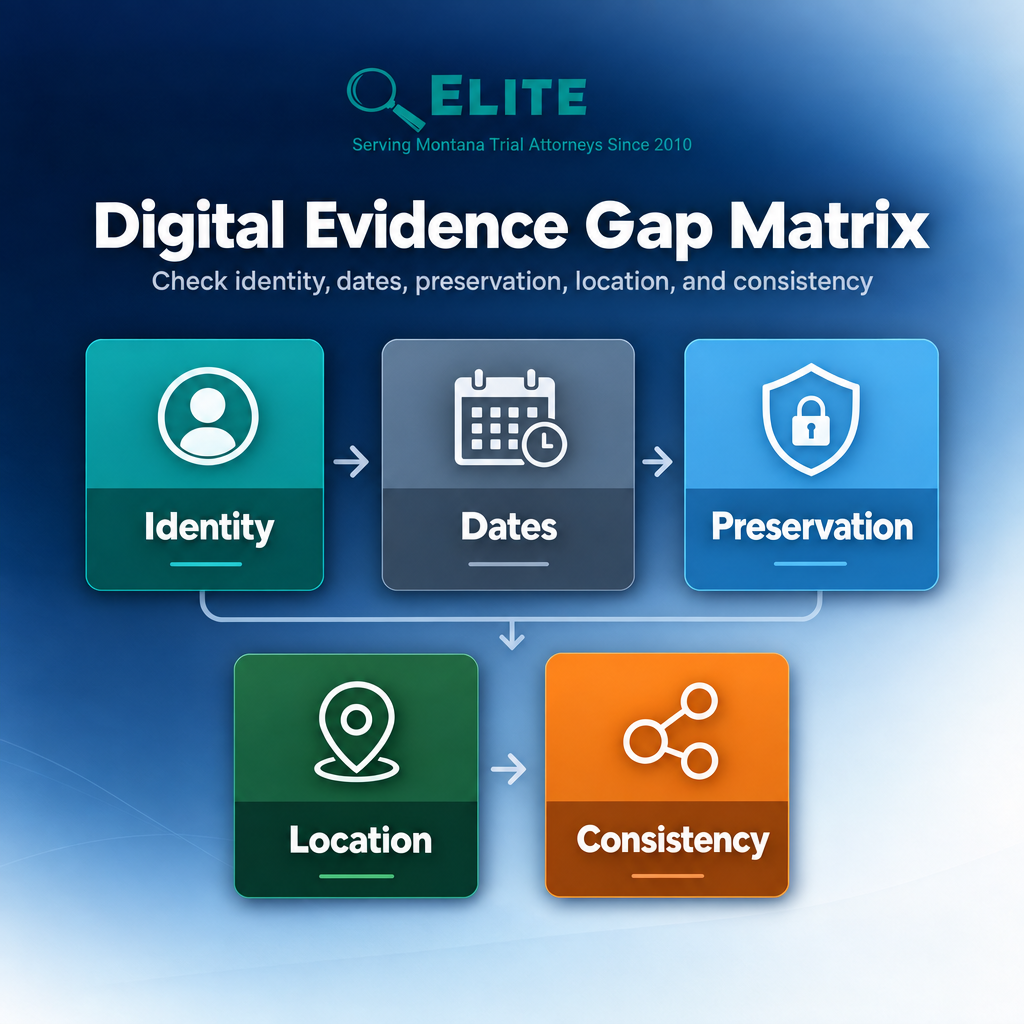
Digital evidence gaps often involve an unverified account, a missing date range, changed public content, inconsistent location claims, or information that was never preserved. A lawful social media investigation may review publicly available profiles, posts, images, videos, usernames, connections, dates, and location indicators that help clarify identity or chronology.
Before work starts, attorneys should define the target person, relevant platforms, date range, search purpose, preservation needs, and permitted methods. A search for identity confirmation has a different scope from a review intended to compare a person’s stated location with publicly visible activity. Clear instructions also help the investigator distinguish a lead from material that can be documented and explained.
Authorization, privacy boundaries, platform terms of service, lawful access, and evidence handling should be discussed in advance. Investigators should not bypass security or obtain information through deceptive or unauthorized methods. When social media information may change, counsel should address preservation promptly and identify how dates, screenshots, source details, and context will be recorded.
Finding missing dates, accounts, and identity links
Missing dates and uncertain identity links should be tested through usernames, profile details, public connections, images, locations, and the sequence of visible posts. We treat those indicators as leads until they are connected to a person and time period with sufficient support. A clear date range prevents a search from collecting irrelevant material and makes later review easier for counsel.
Defining lawful scope before a search begins
Lawful scope should state whose information is being reviewed, which public sources are permitted, what dates matter, and what the investigator must preserve. Attorneys should also identify privacy restrictions, authorization requirements, and any court-related documentation needs. This protects the investigation from drifting into unauthorized access and keeps the resulting work tied to a defined evidence question.
How financial, background, and surveillance inquiries can close factual gaps
Financial, background, and surveillance inquiries are useful when each one addresses a specific unanswered question. Asset searches and bank account searches may help investigate ownership, financial relationships, or unexplained resources when the legal purpose and lawful scope are clearly defined. A background investigation may verify identity, employment history, business affiliations, prior addresses, credentials, or relationships relevant to the matter.
A background report should not be treated as proof of wrongdoing. Likewise, surveillance may help document location, activity, routine, or an event that records and interviews cannot resolve, but the assignment must account for proportionality, safety, privacy, jurisdiction, and lawful conduct.
We recommend stating the unanswered question, known facts, desired deliverable, deadline, geographic scope, and documentation standard for every assignment. Attorneys in civil investigations and criminal investigations can then distinguish an investigative lead from a corroborated finding and decide what additional records or testimony may be needed.
Matching the method to the unanswered question
The method should match the factual problem: witness work for firsthand knowledge, background research for identity or affiliations, asset research for ownership questions, digital review for chronology, and surveillance for observable activity that other sources cannot establish. Combining methods may help, but each added method should have a defined purpose. A focused assignment is easier to supervise, evaluate, and explain to the court or opposing counsel.
Separating useful leads from admissible evidence
Useful leads point investigators toward people, records, locations, or events; they do not automatically establish a fact or satisfy a court’s evidentiary requirements. We recommend labeling preliminary information clearly, preserving source details, recording how information was obtained, and confirming important points through independent evidence where appropriate. Counsel can then decide how the material fits the applicable legal and procedural standards.
What to include in a focused legal investigation request
A focused request should summarize the disputed issue, identify what the current file establishes, list unresolved questions, attach source documents, rank priorities, and set communication and reporting expectations. Separate established facts, assumptions, disputed allegations, and open questions so the investigator can work independently and avoid confirmation bias.
Send records securely and include pleadings, reports, statements, photographs, prior research, known identifiers, relevant dates, locations, deadlines, and restrictions on contact or disclosure. Explain whether the attorney needs an interview summary, chronology, source log, photographs, or another defined deliverable. Elite Investigations provides professional investigative services for attorneys and individuals, including witness locating and interviews, surveillance, background checks, social media investigations, asset searches, bank account searches, and civil or criminal investigations.
A case-gap intake checklist
A useful intake checklist names the central evidence question, the people involved, the locations, the dates, the known records, and the facts that remain unverified. It should also identify urgency, contact limitations, safety concerns, geographic boundaries, and the preferred reporting format. This gives the investigator a practical starting point without directing the result.
Preparing records and instructions for the investigator
Prepare records in a way that preserves their source and context, including file names, dates received, relevant pages, and any prior investigative work. Tell the investigator what is confidential, what cannot be disclosed, and which assumptions need testing. If the matter involves Montana and Wyoming locations, identify each jurisdiction and deadline at intake so the plan reflects the assignment’s actual scope.
When attorneys should bring in an investigator in Montana or Wyoming

Attorneys should consider professional investigative help when a key witness cannot be located, statements conflict on material facts, records are incomplete, a timeline has unexplained gaps, digital information may change, or the legal team lacks time or local capacity to verify leads. Early review can prevent a small unresolved fact from becoming a larger preparation problem.
For matters in Billings, elsewhere in Montana, or extending into Wyoming, discuss geography, deadlines, court requirements, privilege considerations, and evidence-handling expectations during intake. Elite Investigations serves attorneys and legal teams seeking professional investigative services and brings more than 24 years of experience in law enforcement and private investigation. Testimonials supplied to the firm highlight responsiveness, thoroughness, professionalism, and work involving complex factual issues and witness interviews.
To discuss the unanswered questions, available records, locations involved, and investigative support needed, contact Elite Investigations at +1 406-698-8911 or info@elitepimt.com.
Recognizing the point for professional escalation
Escalation makes sense when the legal team has identified a material question but cannot verify it efficiently through its existing file. A missing witness, disputed timeline, unexplained financial connection, or changing digital record can justify a focused assignment. We recommend discussing the issue before conclusions harden, while the investigator can still test competing explanations fairly.
Starting a case-gap review with Elite Investigations
Start by sharing the case type, central evidence question, known locations, relevant deadlines, and current records. We can discuss whether witness locating, interviews, background investigations, social media investigations, asset searches, surveillance, or another service fits the gap. Attorneys can also review our guidance on when to bring a private investigator into a case as they plan next steps.
Frequently Asked Questions
What evidence gaps can a legal investigator help an attorney identify?
A legal investigator may help identify unreachable or unidentified witnesses, conflicting accounts, unverified addresses, incomplete timelines, missing public digital information, unexplained financial connections, and facts requiring field verification. The exact work depends on the case question, lawful scope, available records, and the documentation standard counsel needs.
What should an attorney provide before requesting legal investigation services?
Provide a concise case summary, disputed issues, known facts, unresolved questions, relevant pleadings and records, witness identifiers, key dates, geographic locations, deadlines, contact restrictions, and the preferred report format. Separating facts from assumptions helps the investigator work independently and test the evidence gap fairly.
Does Elite Investigations serve attorneys in Billings and surrounding areas, including Wyoming?
Elite Investigations provides professional investigative services primarily to attorneys in Billings, Montana, surrounding Montana locations, and Wyoming. Confirm the specific location, assignment, and timing directly with the firm before work begins.
How does an attorney get started with a legal investigator?
Contact Elite Investigations with the case type, central evidence question, known locations, relevant deadlines, and current records. An initial discussion can help determine whether witness work, interviews, background research, social media investigation, asset searches, surveillance, or another service fits the evidence gap.