A criminal history background check for a Montana legal case should answer a defined investigative question, identify potentially relevant records, and show what still needs verification. Elite Investigations helps attorneys and clients organize that research so a record search supports sound next steps rather than creating an untested conclusion.
What question should a criminal history background check answer in a Montana case?
Attorneys often need to decide what to investigate next, not simply collect a record. A criminal history background check can help test a specific issue involving a party, witness, employee, contractor, or another person connected to the matter.
Before ordering research, define the original question in writing. Identify the relevant time period, known locations, possible aliases, counties or states involved, and the legal purpose of the search. For example, counsel may need to assess whether a witness’s reported timeline warrants further investigation, whether a contractor has a potentially relevant history, or whether a party may have used another name or jurisdiction.
The legal purpose also controls how the information should be handled. A search can produce leads and context, but it does not automatically establish credibility, liability, identity, or guilt. We recommend treating every result as information that requires source review and careful interpretation before it enters pleadings, negotiations, witness strategy, or client advice.
What can a Montana criminal history search reveal, and what can it leave unresolved?
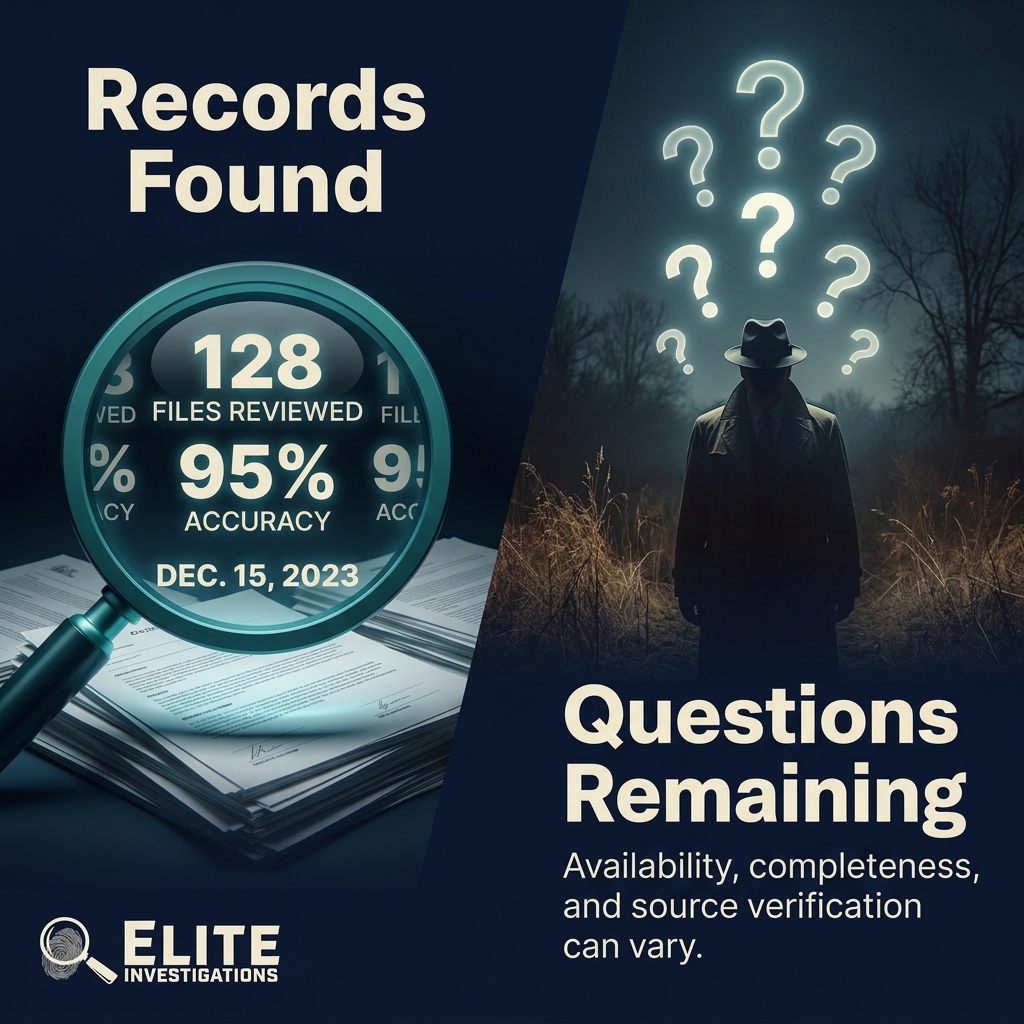
A Montana criminal history search may surface case identifiers, alleged charges, dates, jurisdictions, dispositions, and related public-record references, but availability and completeness vary by source. Montana court records, law-enforcement information, and other public references may each show different portions of a matter.
For every result, record the source, search date, jurisdiction, spelling used, identifiers reviewed, and exact wording. That documentation helps counsel distinguish what the source actually says from an interpretation added later. It also makes a future update or source comparison more efficient.
Records may be incomplete, outdated, sealed, restricted, or affected by clerical errors. An arrest, charge, conviction, dismissal, deferred outcome, and other case disposition carry different meanings. A database entry may identify a case without explaining the underlying court action, and the absence of a result does not necessarily prove that no relevant event occurred.
Potential records and source boundaries
A search may identify filings or references connected to a person, but each source has boundaries that should be stated clearly. A result can point toward Montana court records, a particular county, another state, or a related public record without resolving every fact. We document those boundaries so the report does not imply broader coverage than the research supports.
Questions that require additional verification
An unclear result may require checking underlying court materials, confirming the disposition, locating a witness, conducting an interview, reviewing publicly visible social media, or pursuing location work. Those steps should match the unresolved question, because a record alone may not explain identity, timing, conduct, or the relationship between a person and a case.
How can attorneys reduce identity confusion and misread results?
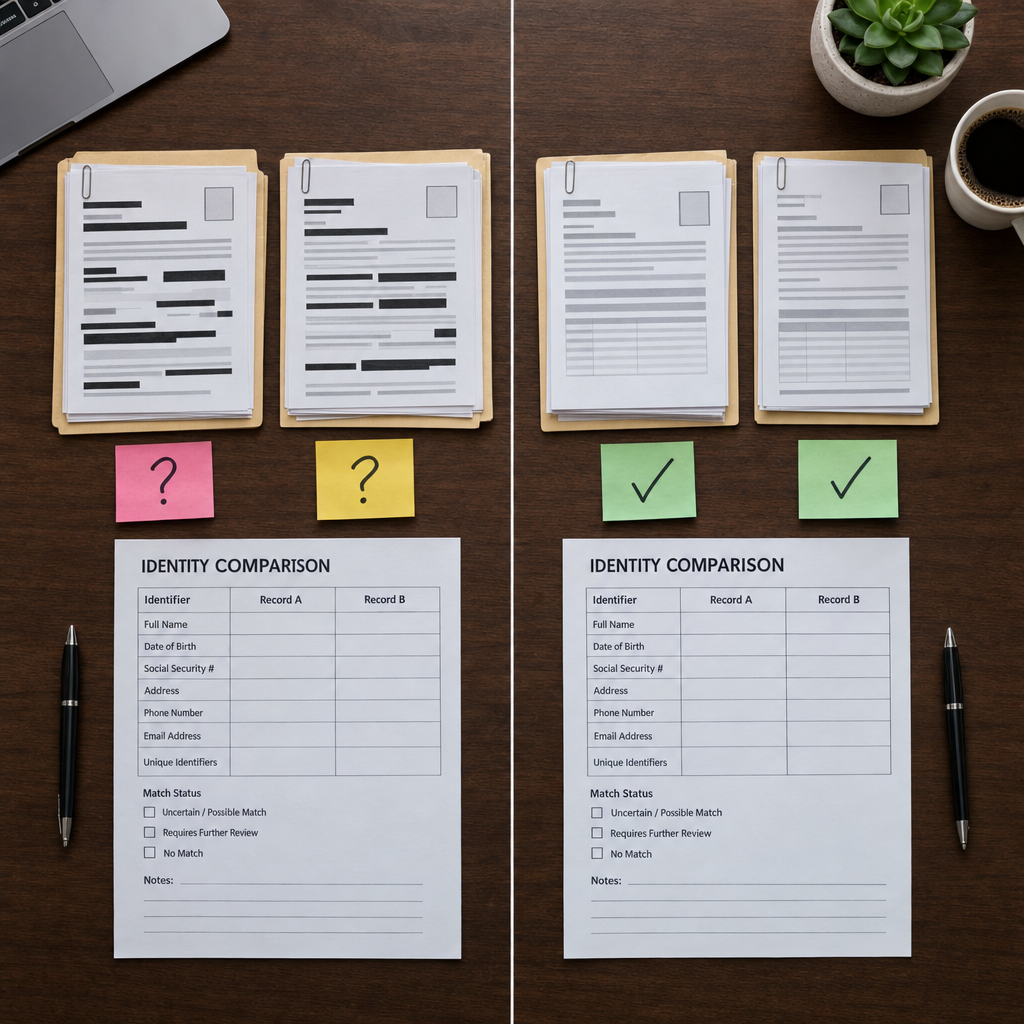
Attorneys can reduce false matches by comparing several lawful identifiers before treating a record as relevant. Common names, limited identifiers, aliases, and records spread across jurisdictions create a real risk that information will be assigned to the wrong person.
We recommend reviewing the following details when lawfully available:
Identity review: Compare the full name, known aliases, date of birth, prior addresses, county or state, employer information, and other distinguishing details. Note which details came from a source and which came from a client or another person.
Separate verified source information from assumptions in investigative notes, reports, pleadings, and client communications. Use precise language such as “the search returned a record with these identifiers” until the underlying material confirms that it belongs to the person under investigation.
Counsel should also review applicable court rules, privacy requirements, discovery duties, and employment-screening requirements. If the search is used for a regulated screening purpose, the Fair Credit Reporting Act may apply depending on the circumstances and the parties involved. We recommend obtaining legal advice about the specific use rather than assuming that information gathered for litigation may be used in every other setting.
What should happen after a criminal history background check raises a new lead?
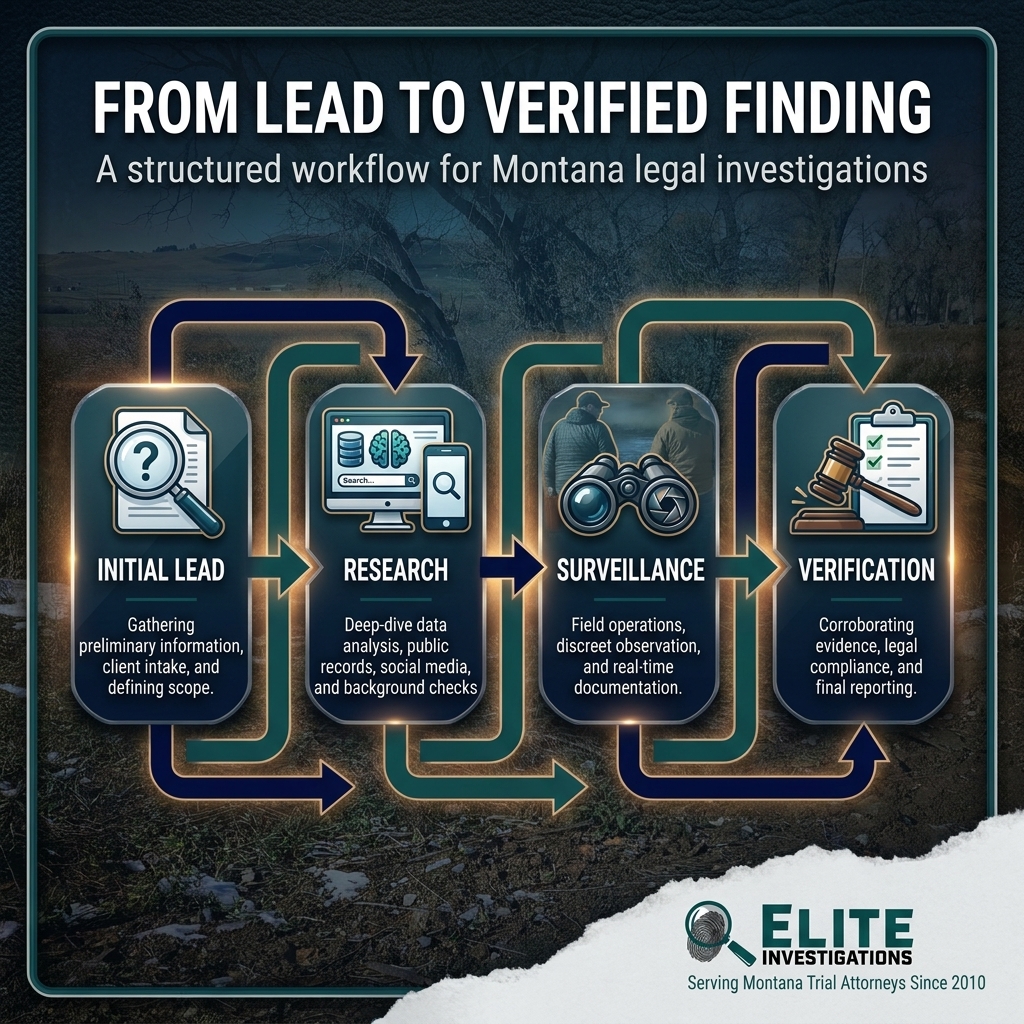
A new lead should move through source verification, issue ranking, targeted follow-up, documentation, and attorney review. The following workflow keeps the investigation tied to the original case question.
- Restate the question: Identify the decision the search is meant to support and define the relevant person, time period, jurisdiction, and legal purpose.
- Verify the source: Preserve the result, search date, spelling, identifiers, jurisdiction, and exact wording. Check underlying court information when appropriate.
- Rank the issue: Decide whether the lead affects identity, timing, witness reliability, conduct, damages, liability, or another defined issue.
- Select targeted follow-up: Use witness locating and interviews for firsthand context, surveillance for activity questions, social media investigations for publicly visible timelines, or broader background and asset research when relevant.
- Document limitations: Record what remains unknown, which sources were reviewed, and why additional work was or was not pursued.
- Return findings to counsel: Have the attorney review the information before using it in litigation, negotiations, client advice, or witness strategy.
A case-preparation workflow
A disciplined workflow prevents an unexpected result from expanding the investigation without purpose. We recommend preserving the initial information, confirming the identity and disposition, connecting the lead to a specific case issue, and setting a clear stopping point or follow-up assignment. Counsel can then decide how the verified information fits the legal strategy.
Choosing the next investigative method
The best follow-up method depends on the unanswered question. Witness locating and interviews may clarify firsthand events; surveillance may address a disputed activity pattern; social media investigations may help examine a publicly visible timeline; and related background or asset research may address a broader legal issue. Each method should have a defined lawful scope and documentation plan.
When should a Montana attorney use an investigator instead of relying on a record search alone?
An attorney should consider investigator support when identities conflict, records span multiple jurisdictions, dispositions are unclear, witnesses are difficult to locate, timelines are disputed, or the case requires a connection between records and real-world evidence. Those conditions often require more than a database result.
A private investigator can help organize the investigative question, pursue lawful follow-up, document sources, and coordinate related services without treating an unverified result as established fact. The investigator’s role is especially useful when counsel needs a structured review of what is known, what is missing, and which next step can answer the open question.
Elite Investigations provides professional investigation services to attorneys in Billings and surrounding Montana areas, including Wyoming. Our legal investigation services include background checks, witness locating and interviews, surveillance investigations, and social media investigations. We also support broader civil and criminal investigations when the case calls for related research.
Our team is known through attorney testimonials for responsiveness, thoroughness, and professionalism in complex matters, and Elite Investigations was featured on Oxygen Network’s “Murdered & Missing in Montana.” If you have a defined case question, contact Elite Investigations to discuss the intended scope, jurisdiction, and next step.
How will criminal history research fit into legal investigations over the next one to three years?
Criminal history research will continue to require source verification as courts, public databases, online identities, and record-access practices change. Attorneys should expect greater emphasis on documenting search scope, source reliability, identity matching, update dates, and known limitations.
A single database result should not be treated as complete or permanent. Records may change as cases proceed, sources update their information, or additional court material becomes available. Repeatable protocols give law firms a consistent way to preserve the original search, compare later results, and explain why a finding was considered relevant or unresolved.
Our practical recommendation is to define the case question, preserve the initial information, and ask an investigator to assess whether records, interviews, surveillance, social media research, or another method should follow. Attorneys and clients in Billings, Montana, surrounding areas, and Wyoming can discuss a legal investigation with our team before relying on an unclear result.
Frequently Asked Questions
What is the purpose of a criminal history background check in a Montana legal case?
Its purpose is to identify potentially relevant records and investigative leads connected to a defined case question. The search does not by itself establish identity, credibility, liability, or guilt, so counsel should verify important findings before relying on them.
Can a Montana criminal history background check confirm that a record belongs to a specific person?
Confirmation requires careful identity matching across available identifiers and source records. Common names, aliases, incomplete identifiers, and limited jurisdictional information can create false matches, so unresolved records should be verified before use.
What should an attorney do when a background check reveals an unclear or unexpected result?
Preserve the source, search details, date, jurisdiction, identifiers, and exact wording. Then review underlying court information where appropriate, separate facts from assumptions, and decide whether witness interviews, locating work, surveillance, social media research, or another method addresses the open question.
Does Elite Investigations provide criminal history background checks for cases in Montana and Wyoming?
Elite Investigations provides investigation services to attorneys in Billings and surrounding areas, including Wyoming, and offers background checks and related legal investigation services. Contact the firm to discuss the specific matter, jurisdiction, and intended scope.
How do I get started with a criminal history background check for a Montana legal case?
Prepare the person’s known identifying information, the original investigative question, relevant jurisdictions, deadlines, and intended legal use. You can contact Elite Investigations through the firm’s contact page or by phone at +1 406-698-8911 to discuss the matter.