A national criminal background check helps attorneys identify possible records across multiple jurisdictions, but it should be treated as an investigative starting point rather than a complete criminal history. We recommend defining the case question first, then confirming any meaningful result through the relevant jurisdiction or court.
What case decision requires a national criminal background check?
A broad criminal-record search is most useful when an attorney needs an early view of possible records, jurisdictions, or identity leads before deciding what investigative work should follow. You may need to identify a person connected to a legal investigation, locate leads across several states, assess information before a witness interview, or plan surveillance and other factual development.
The right question determines whether a national search is appropriate. Are you trying to confirm identity, find possible records, identify jurisdictions for follow-up, or obtain a lead that can be verified through court-level research? Defining that question keeps the report from being treated as more conclusive than it is.
We view a national criminal background check as an initial map of potential information. It may help guide witness locating, interviews, background investigations, asset searches, surveillance planning, or broader civil and criminal investigative work. It does not, by itself, establish that a particular record belongs to the subject, show that the record is complete, or resolve the legal significance of a case disposition.
Attorneys and law firms handling matters in Montana, Wyoming, or multiple jurisdictions can use the search to decide where additional research belongs. For a related discussion of jurisdiction-specific work, see our article on criminal history background checks for Montana legal cases.
How should attorneys compare national criminal background check providers?
Attorneys should compare providers by asking exactly what the search covers, how results are reported, and whether the provider can help investigate a possible match. A broad database search and direct research in a named court or jurisdiction are different services, so the report should make that distinction clear.
- Search scope: Ask whether the search is national, multi-state, county-level, or limited to selected jurisdictions. The scope determines whether the result can help identify where follow-up research may be needed.
- Source types: Ask what categories of records or sources are reviewed and how the provider describes source limitations. This affects whether the report offers a lead, a jurisdiction reference, or information ready for verification.
- Geographic coverage: Ask how the provider handles Montana, Wyoming, and any other states connected to the person or matter. Geographic detail helps prevent an apparently broad search from being mistaken for equal coverage everywhere.
- Record-date limits: Ask what date ranges apply and whether older, incomplete, or recently updated information may require additional research. Dates affect how an attorney evaluates relevance and next steps.
- Turnaround expectations: Ask when the report should be expected and what could delay jurisdiction-level follow-up. A quick lead may help early planning, while a time-sensitive filing may require a separate discussion about research priorities.
- Report format: Ask whether the report identifies names, aliases, dates, jurisdictions, and unresolved limitations in a clear format. A readable report makes it easier to preserve the investigative trail and separate leads from verified facts.
- Verification support: Ask whether the provider can assist with jurisdiction research, background investigations, or related factual development. This matters when a possible match needs more than a database result.
We also recommend comparing experience with legal investigations, responsiveness, investigative judgment, and the ability to work through complex factual questions. Elite Investigations provides background investigations and legal investigative services for attorneys and clients in Montana and surrounding areas, including Wyoming. Those capabilities can matter when a search becomes part of a larger investigation.
Which identifiers determine whether a record belongs to the right person?
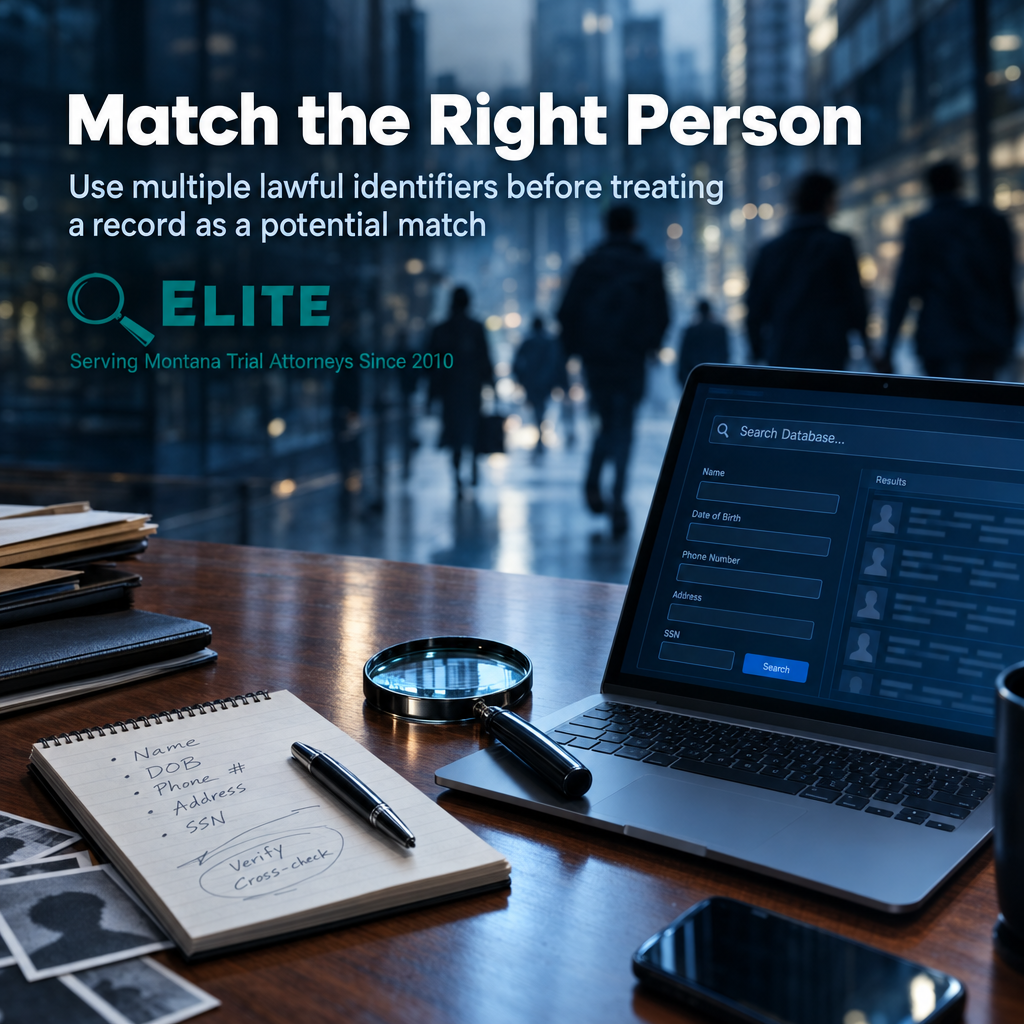
Identity review should begin with lawful, consistent identifiers gathered before the search, including the person’s full name, known aliases, date of birth, prior addresses, and relevant geography. These details help investigators separate a possible match from an unrelated person with a similar name.
Incomplete or conflicting identifiers can create false matches, missed records, or an unclear identity trail. We recommend asking how the provider handles similar names, spelling variations, aliases, duplicate entries, incomplete dates of birth, and conflicting address history. This is an investigative quality-control step, not a final legal conclusion.
Names, dates of birth, and aliases
Full names and dates of birth provide an initial way to compare a person with a possible record, while former names, aliases, and spelling variations can reveal why one person appears under more than one identity label. A name-only result deserves additional review before it affects legal strategy. We recommend preserving every identifier used and noting which details support or weaken the proposed match.
Addresses and jurisdiction history
Current and former addresses can point investigators toward relevant counties, states, courts, or other jurisdictions for follow-up. Attorneys should document known geography and compare it with locations listed in the report, while recognizing that address information may be outdated or incomplete. A geographic inconsistency does not resolve identity by itself, but it signals a question for further research.
What can a national search reveal, and what can it leave unresolved?
A national search may reveal potential criminal-record leads, jurisdiction references, names or aliases, dates, and other information that helps direct additional investigation. The value of each entry depends on the source, reporting method, available data, record type, date range, and jurisdiction.
Coverage can vary because courts and other record sources do not necessarily publish or update information in the same way. A report may point to a county or state without showing a complete case history. It may also contain information that requires identity comparison, current-status review, or direct court confirmation.
Before relying on a result, attorneys should flag the following questions:
- Question: Does the possible record match the subject’s full identity, aliases, date of birth, and address history?
- Question: Is the record current, and does it show a complete or final disposition?
- Question: Which jurisdiction or court holds the information needed for verification?
- Question: Could another jurisdiction require separate research because the broad search has coverage limits?
- Question: Does the report clearly distinguish a lead from a verified court record?
Our related guidance on background checks for attorneys handling sensitive legal matters can help with the broader review process.
How should attorneys verify a possible record before relying on it?
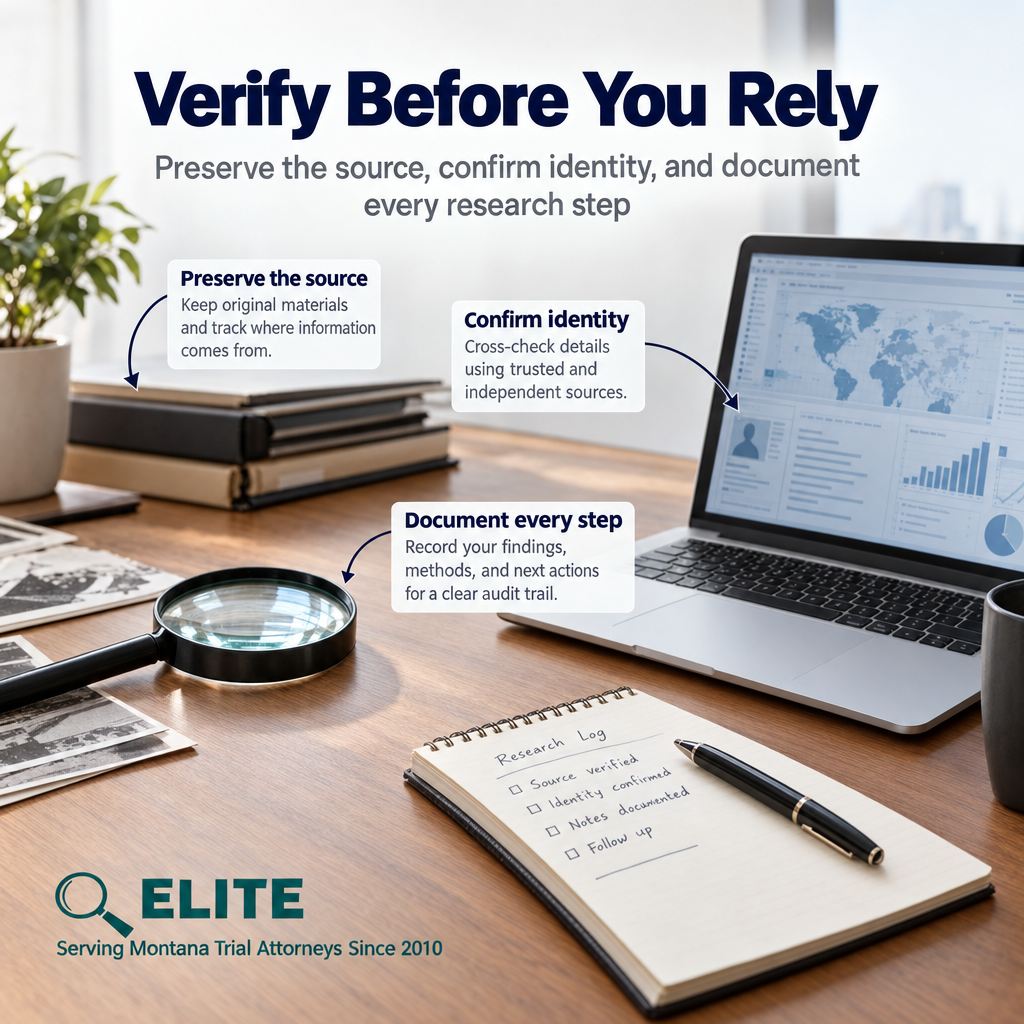
Attorneys should verify a possible record through a documented sequence before treating it as a factual assertion. First, preserve the original report and record the search date. Next, compare the subject’s identifiers with the information associated with the possible record.
Then identify the relevant county, state, court, or other jurisdiction and obtain or inspect the appropriate court information. Review the case status and disposition, determine whether the record is complete, and document how the information was confirmed. The case file should identify the source, identifiers reviewed, follow-up questions, and unresolved limitations.
A practical verification sequence is:
- Preserve the report in its original form.
- Compare names, aliases, dates of birth, addresses, and other available identifiers.
- Identify the jurisdiction that can confirm the possible record.
- Obtain or inspect the appropriate court-level information.
- Review case status and record disposition.
- Document the verification path and any remaining uncertainty.
A possible match should remain a lead until the relevant jurisdiction or court record supports it. An investigative professional can assist with jurisdiction research, background investigations, witness interviews, and related factual development, while counsel retains responsibility for legal interpretation and case strategy.
What privacy and fair-use checks belong in the review process?
Attorneys should define who may access the report, how sensitive personal information will be stored, and how investigative material will be shared within the legal team. Before ordering or using a search, confirm that the search and intended use fit the legal, professional, privacy, and fair-use requirements that apply to the matter.
Internal notes should separate verified facts, unverified leads, investigator observations, and counsel’s legal analysis. That separation helps the team understand what the report actually establishes and what still requires confirmation. It also creates a clearer record of why additional research was requested.
Elite Investigations provides background checks and legal investigation services for attorneys and clients in Montana and surrounding areas, including Billings, Montana, other Montana communities, and Wyoming. Our team focuses on professional investigative support for complex factual questions. Contact Elite Investigations to discuss whether a national criminal background check, jurisdiction research, or related investigation fits your case question.
Frequently Asked Questions
Is a national criminal background check enough for an attorney to rely on a possible record?
A national criminal background check can identify leads, but it may not establish identity, completeness, current status, or disposition. Attorneys should confirm meaningful information through the appropriate jurisdiction or court before using it to shape legal strategy or present it as a fact.
What information should an attorney provide before ordering a national criminal background check?
Provide lawful identifying information such as the person’s full name, known aliases, date of birth, prior addresses, and relevant geography. Better identifiers can reduce false matches and help direct jurisdiction-level follow-up when the report identifies a possible record.
What does a national criminal background check typically include?
Depending on the provider’s sources and scope, a report may include potential criminal-record leads, names, aliases, dates, and jurisdiction references. The contents depend on coverage, record availability, date limits, and reporting method, so attorneys should ask what the report does and does not establish.
Can a national criminal background check miss records?
Yes, a broad search may have jurisdiction, source, date, data-quality, or reporting limitations. Ask what is searched, what is excluded, how coverage varies, and which jurisdictions require separate research before concluding that no additional record exists.
Can Elite Investigations help attorneys review background-check information?
Elite Investigations provides background checks and legal investigation services for attorneys and clients in Montana and surrounding areas, including Wyoming. Contact our team to discuss the investigative question, the available identifiers, and whether jurisdiction research or related factual support is appropriate.