Before an initial investigator consultation, prepare a clear question, a dated timeline, relevant identifiers, supporting records, and every deadline that could affect the assignment. Organized information helps us determine whether the matter calls for public-information research, social media investigations, witness locating and interviews, background checks, asset searches, surveillance investigations, or another investigative approach.
Define the question you need the investigator to answer
A consultation works best when you arrive with a decision or legal question, rather than only the feeling that something is wrong. Without a focused question, a usable timeline, or a defined decision, an investigator may need to spend valuable consultation time separating concerns from actionable facts.
State what outcome would help you decide what to do next or move a legal matter forward. For example, you may need to identify a witness, verify a person’s background, locate relevant assets, review public online information, assess whether surveillance is appropriate, or organize records for an attorney. Avoid presenting conclusions about another person as established facts; describe what you observed and what you need tested.
Attorneys and law firms may need the work aligned with discovery, witness development, litigation strategy, or a filing deadline. Individuals may need help describing a concern and identifying which facts can be independently documented. Those different needs affect the consultation, documentation, and next steps.
Turn a general concern into a specific investigative objective
Write the objective as a question that the investigator can investigate and document. “Can you determine whether this person has another residence during this date range?” is more useful than “Find out what they are hiding.” A focused objective helps us discuss the appropriate service, expected records, geographic needs, and realistic limits before work begins.
Separate facts you know from assumptions you need tested
Label each point as firsthand information, information received from someone else, or an assumption that requires verification. Include the source and date when possible, then identify what evidence would confirm or challenge it. This distinction helps us plan lawful investigative steps without treating an unverified allegation as a conclusion.
Build a fact packet with names, dates, records, and digital clues

A useful fact packet gives the investigator enough identifiers to distinguish the correct person, event, account, or record. Gather full names, aliases, known addresses, phone numbers, email addresses, usernames, dates, locations, photographs, vehicle details, employers, court-related documents, and relevant correspondence.
Label every item with its source, date received, and apparent relevance. Preserve original files separately from working copies, especially for screenshots, profile links, public posts, text messages, photographs, and documents. Original files may retain useful metadata, while a labeled copy can make review easier. Do not edit, crop, or annotate the original digital material.
- Write the objective: State the question and the decision the work should support.
- Create the timeline: List events, locations, and sources in date order.
- Gather identifiers: Collect names, aliases, contact details, usernames, photos, and vehicle information.
- Sort supporting records: Group correspondence, court materials, messages, photographs, and links by topic.
- Mark gaps and deadlines: Identify missing records, preservation concerns, hearings, filings, and time-sensitive events.
Use a timeline to show what happened and when
A dated timeline lets us compare reported events with records, locations, communications, and known movements. Include the event, approximate time, location, source, and any uncertainty rather than forcing an exact date. Mark filing dates, hearings, planned meetings, or disappearing digital content so timing can be discussed during the consultation.
Organize online identifiers without altering the original information
Keep usernames, profile links, display names, platform names, screenshots, and capture dates together in a simple index. Record whether an account was identified directly, supplied by another person, or found during prior research. Preserve the original screenshot or download and use a separate note for observations, because changing the source file can complicate later review.
Decide which consultation details affect scope, timing, and method
Share the relevant jurisdiction, locations, service area, known movements, filing dates, hearings, preservation concerns, and time-sensitive events before an investigation is planned. Geography and timing can determine whether the work primarily involves public-information research, online review, interviews, records work, surveillance, or field coordination.
Online private investigation services may focus on publicly available information and social media review, while witness locating, interviews, surveillance, and location work may require field resources. Tell us whether the matter involves Billings, Bozeman, Butte, Missoula County, Anaconda, Baker, another Montana location, or Wyoming. Elite Investigations serves Billings, surrounding Montana communities, and Wyoming, with legal investigations, witness locating and interviews, background checks, asset searches, and social media investigations.
Explain urgency, legal deadlines, and geographic coverage
Give the investigator every deadline that could change the order or feasibility of the work, including hearings, filings, preservation concerns, travel dates, and planned contact with a witness or subject. Identify all relevant locations, not just the address where the issue began. This allows the consultation to address travel, coordination, and whether the requested timing is realistic.
Match the request to online research, fieldwork, or a combined approach
Ask whether the objective can be addressed through public-information research, social media review, interviews, records, surveillance, or a combination of methods. A digital question may still require field verification, while a witness matter may benefit from online identification work first. Matching method to objective helps control unnecessary scope and clarifies what evidence may be documented.
Ask how online research will be handled and documented
Before authorizing online private investigation services, ask how lawful access, source verification, privacy boundaries, screenshots, URLs, timestamps, evidence handling, and report organization will be addressed. Social media searches should have an agreed scope that identifies platforms, usernames or other identifiers, relevant dates, public information to review, and the type of findings requested.
Ask what the final report will show and what it will not establish. Confirm whether source links, capture dates, screenshots, notes, and limitations will be included. Also ask how sensitive files will be transmitted, who receives updates, and which questions would require additional work.
There is no responsible way to quote a fee without understanding the assignment. Ask which factors affect cost, including research scope, number of subjects, records requested, travel, urgency, reporting, follow-up, and related services. A clear discussion of these factors is more useful than treating every social media search as the same service.
Clarify privacy, lawful access, and evidence-handling practices
Ask whether the proposed work relies on lawful public-information research and how the investigator avoids unauthorized access to private accounts or restricted records. Discuss how screenshots, URLs, timestamps, downloaded files, and notes will be preserved and organized. If the matter may become part of a legal proceeding, ask what documentation and handling practices are available for the assignment.
Confirm communication, reporting, and update expectations
Agree on who receives updates, how often meaningful developments are reported, and how urgent information will be communicated. Ask whether the final deliverable includes a written report, source references, screenshots, a chronology, or identified limitations. Confirm how follow-up questions are handled and what additional work would fall outside the initial scope.
Use the first meeting to evaluate fit, qualifications, and next steps
Use the consultation to compare the investigative objective with the investigator’s relevant experience, proposed methods, geographic coverage, milestones, documentation, communication process, confidentiality practices, and required client information. Elite Investigations provides professional investigative services for attorneys and individuals, including complex legal investigations, and has more than 24 years of experience in law enforcement and private investigation related to infidelity cases.
Attorneys can explain how the assignment connects to litigation strategy, witness development, discovery needs, or case deadlines without asking the investigator to decide the legal merits. Individuals should describe the concern, provide verifiable facts, ask which service fits, and understand what a private investigator can realistically document. A consultation should clarify the work, not promise a particular result.
Questions attorneys and law firms should ask
Ask about experience with the relevant investigation type, proposed methods, Montana and Wyoming coverage, expected milestones, report format, communication, confidentiality, and the information counsel must supply. Clarify how the assignment can support witness development, discovery, or a litigation deadline. Also ask which tasks are included, which are excluded, and what facts would require a revised plan.
Questions individuals should ask before authorizing work
Ask which service best matches the concern, what facts can be independently verified, what information you should provide, and what limitations apply. Discuss privacy boundaries, communication, documentation, timing, and the factors that affect cost. Individuals should leave knowing what the investigator can document and which questions may require additional records or work.
Leave the consultation with a documented action plan
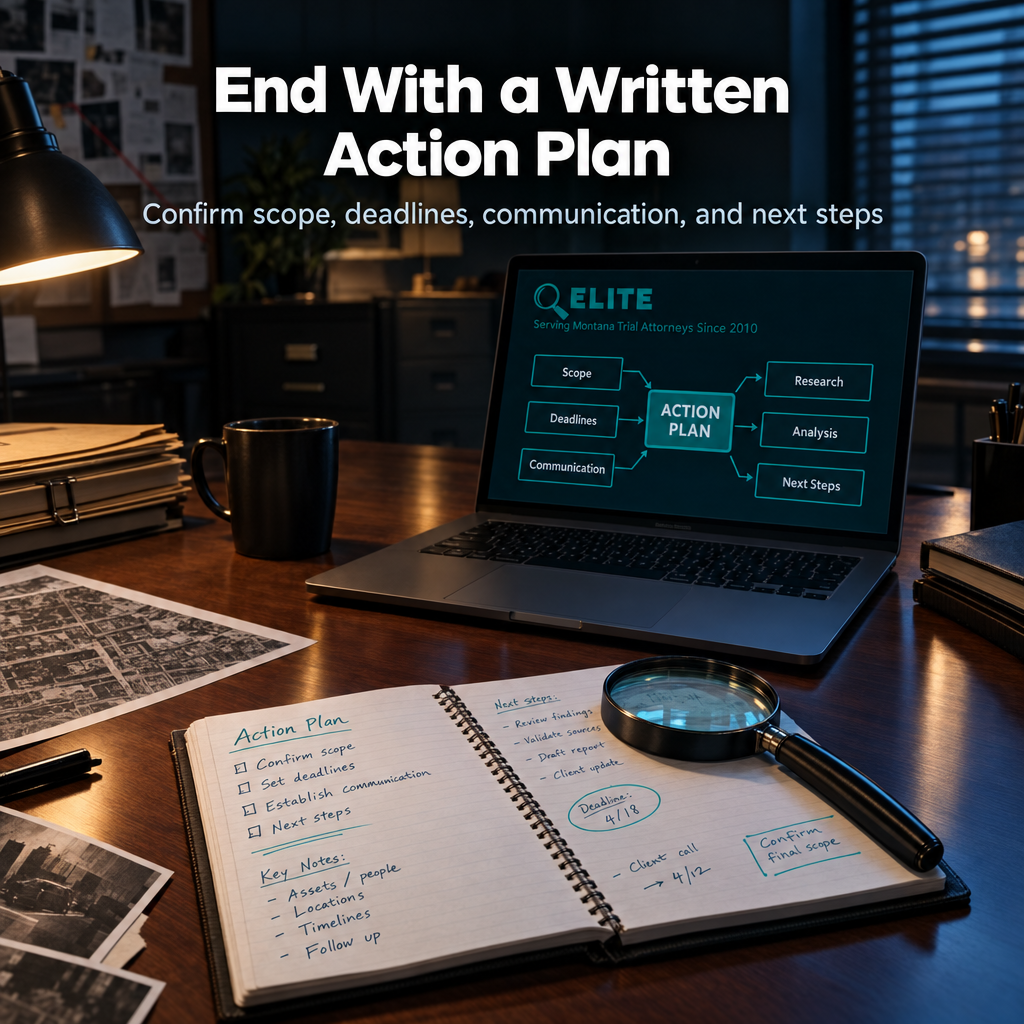
A useful post-consultation summary identifies the investigative objective, included and excluded tasks, locations, known subjects, records to review, communication process, deadlines, and agreed next actions. It should also identify missing information, preservation steps, consent or authorization questions, and events that could change the assignment.
Keep a dated record of every material provided and every new fact discovered after the meeting. This is especially helpful when an attorney, client, insurer, business, or other stakeholder contributes information. Before authorizing work, make sure everyone understands the scope and the next decision point.
Confirm scope before authorizing investigative work
Confirm the subject, objective, locations, methods, deliverables, deadlines, communication process, and exclusions before work begins. Ask how a change in the objective or discovery of a new subject will be handled. Written scope reduces misunderstandings and gives the investigator a clear basis for identifying additional information or work that may be needed.
Prepare for follow-up requests and changing facts
Expect the investigator to request clarification when names, dates, accounts, or locations remain incomplete. Respond with dated additions and preserve new source material in its original form. To discuss an investigative need and determine what to prepare, contact Elite Investigations at (406) 698-8911 or info@elitepimt.com.
Frequently Asked Questions
What should I bring to an initial private investigator consultation?
Bring a clear investigative question, dated timeline, names and aliases, known addresses and phone numbers, usernames, photographs, documents, messages, relevant links, and deadlines. Keep original files and identify which information is firsthand, received from someone else, or still unverified.
What is included in an online private investigation or social media search?
The scope should be agreed before work begins. It may include lawful review of publicly available information tied to identified people, accounts, dates, or issues, with source documentation and reporting. Ask which platforms, identifiers, dates, deliverables, and limitations apply.
How much do online private investigation services cost?
A reliable estimate depends on the assignment’s scope, number of subjects, research depth, urgency, reporting needs, travel, and related services. Ask which factors determine the estimate and what work is included before authorizing it.
Is an investigator consultation appropriate for attorneys, law firms, and individuals?
Yes. Attorneys and law firms can connect the assignment to case needs and deadlines, while individuals can explain the concern, organize supporting information, and identify a suitable investigative service.