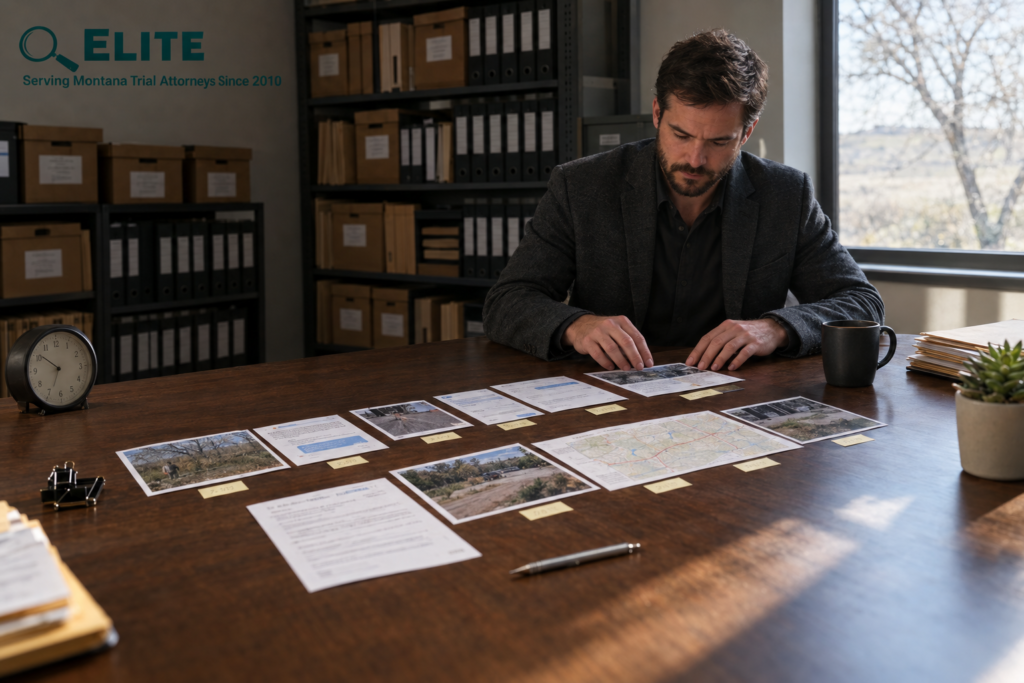
Investigators turn scattered messages, records, online activity, and witness accounts into a documented sequence that shows what happened, when it happened, and which facts still need verification.
Why a legal timeline becomes difficult to establish
A reliable timeline is difficult when attorneys, law firms, or individuals have plenty of information but no verified sequence of events. Messages may show a conversation without confirming where someone was, documents may use different dates, and recollections may conflict about who arrived first or what happened afterward.
Unknown locations, missing witnesses, deleted or edited online content, and activity across several communication channels can create gaps that are easy to overlook. A timeline may look complete until one unsupported assumption affects several later events. That is why the first investigative question should define what the chronology must establish: when an event occurred, who was present, where it happened, or what took place before and after it.
Online private investigation services can help identify leads and connect public information to known dates, but online research is not automatically a complete legal investigation. Depending on the gap, the work may also require records review, witness locating and interviews, surveillance investigations, background checks, asset searches, or other legal investigations.
How incomplete dates and scattered records create gaps
Incomplete dates create gaps because a record often confirms activity without confirming the event that matters. A post may indicate that someone was in a particular area, while a message, receipt, or witness account may be needed to place that activity within the larger sequence.
We recommend separating exact timestamps from estimated dates and identifying every source behind an entry. This prevents an assumption from appearing in the chronology as a confirmed fact.
Which unanswered questions should guide the inquiry
The central question should state the decision the timeline needs to support. It may ask whether a person was present, whether a statement matches available records, or whether an event occurred before a legal notice or other documented action.
A focused question helps a private investigator select relevant sources and avoid collecting information that does not resolve the disputed point. It also gives attorneys and individuals a clear way to assess whether each finding matters.
What to prepare before requesting online private investigation services
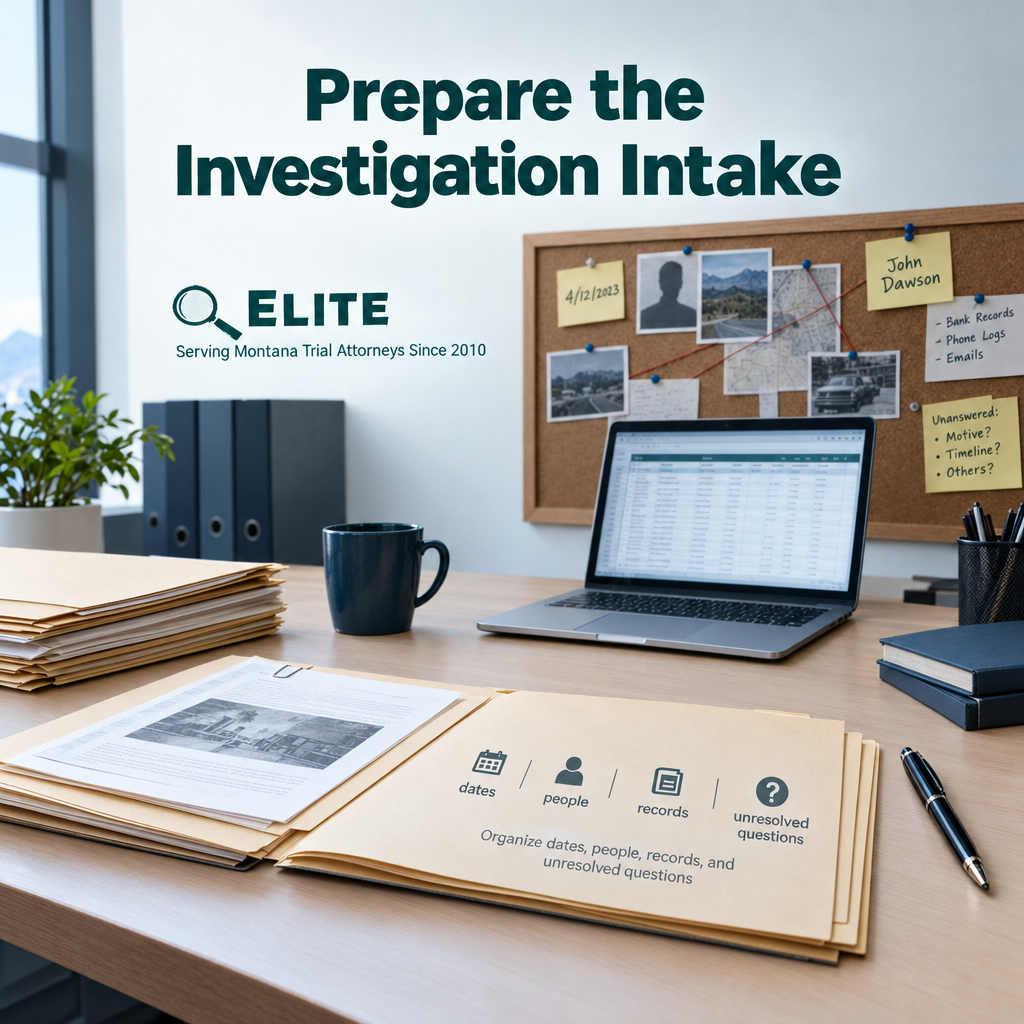
A focused intake gives an investigator the context needed to find missing links without requiring you to request every available method at once. Before contacting Elite Investigations, organize the material around one central timeline problem and distinguish confirmed facts from assumptions, disputed statements, and leads that still need verification.
- Central question: State the date, event, relationship, or sequence that needs clarification.
- Date range: Identify the earliest relevant date, latest relevant date, and any uncertain periods.
- People: List names, aliases, employers, known relationships, and other identifying details.
- Locations: Record known addresses, workplaces, communities, travel points, and possible jurisdictions.
- Communications: Gather relevant messages, emails, call records, posts, photographs, and account information without selectively editing the material.
- Existing documents: Include reports, notices, contracts, filings, receipts, photographs, and other records already available.
- Decision supported: Explain whether the findings will help guide litigation strategy, a civil investigation, a criminal investigation, a risk review, or another legal decision.
Do not alter, delete, or selectively edit potentially relevant records before discussing preservation and investigative needs. Keeping the original context helps an investigator evaluate timestamps, surrounding messages, document history, and possible contradictions.
The facts, dates, people, and locations to organize
Organize the material in date order, but label uncertain information as uncertain rather than forcing it into a precise slot. Include the source of each fact, the people connected to it, and the location associated with the event.
When several names, accounts, or addresses may refer to the same person, note the reason for that connection. This gives the investigator a starting point for identity checks and prevents unrelated information from entering the timeline.
A practical intake checklist for the first consultation
Bring a short written summary, the most relevant records, a list of unresolved dates, and the outcome you need the investigation to inform. Explain what you know directly, what someone else reported, and what remains an untested lead.
That preparation helps the investigator discuss suitable methods, possible limitations, geographic coverage, documentation, and whether online research should be combined with fieldwork or interviews.
How investigators connect digital findings with real-world events

Investigators connect digital findings with real-world events by comparing online activity with records, locations, witness accounts, and other evidence rather than treating a single post or profile as conclusive. Social media investigations may help identify dates, relationships, locations, public statements, or changes in activity.
Witness locating and interviews can clarify who observed an event, what that person remembers, and whether the account fits the existing sequence. Background checks may help verify identity or relevant history, while surveillance investigations may address present-day activity that affects a disputed timeline. Asset searches may address ownership or financial questions, and legal investigations may combine several methods around a defined case issue.
Each finding should be documented with source details, collection date, relevant time zone, location information, and an explanation of how it supports, challenges, or fails to resolve a timeline point. This structure helps attorneys distinguish a useful lead from a verified fact.
Social media searches and online activity
Social media searches can identify public activity connected to specific people, dates, accounts, locations, or events, but online information requires context and verification. Profiles may be incomplete, content may be reposted, timestamps may reflect a different time zone, and apparent relationships may not establish what happened offline.
We recommend asking which sources will be reviewed, how findings will be captured, and which limitations will appear in the final documentation. The search should serve a defined timeline question rather than become an unfocused review of every available account.
Witness interviews, background checks, and surveillance
Witness interviews are useful when a missing person may confirm who was present, what was observed, or how events unfolded. Background checks can help clarify identity and relationships, while surveillance may address a defined question about activity, location, or conduct during a relevant period.
These methods answer different questions and should not be treated as interchangeable. We recommend tying each method to a specific timeline gap and recording whether the result confirms, contradicts, or leaves that gap unresolved.
Asset searches and records-based verification
Asset searches and records-based verification can help test claims about ownership, financial interests, or relationships that affect the chronology. They may be relevant when a transaction, business connection, property, or account needs to be placed within a sequence of events.
The value depends on the question being asked and the records available for review. Investigators should identify the source, date, jurisdiction, and limits of each record instead of presenting a records-based lead as proof of an entire event.
Which questions clarify scope, cost, and geographic coverage
Ask exactly what the investigation includes, which sources will be reviewed, how social media search costs will be determined, and what deliverable you will receive. Also ask whether the report will identify collection dates, time zones, source limitations, unresolved questions, and recommended follow-up.
Scope and cost may depend on the number of people, date range, platforms or records involved, verification requirements, urgency, travel, and whether interviews, surveillance, or other investigative methods become necessary. A narrow online review and a multi-jurisdiction timeline require different planning.
Elite Investigations provides professional investigation services in Billings, Montana, and surrounding areas, including Wyoming. Before work begins, confirm whether the inquiry involves Billings, Bozeman, Butte, Missoula County, another Montana community, or a location in Wyoming.
How social media search costs may be determined
Social media search costs are generally shaped by the number of subjects, date range, relevant platforms, verification needs, urgency, and reporting requirements, so a fixed price should not be assumed before the scope is understood.
Ask whether the quoted work covers identification, collection, analysis, documentation, and follow-up verification. Also clarify what happens if the online findings reveal a need for witness locating, records review, or field investigation.
When Montana or Wyoming coverage changes the plan
Montana or Wyoming coverage may change the plan when witnesses, records, locations, or relevant activity fall outside one local area. Travel, multiple jurisdictions, and coordination between online research and fieldwork can affect the method and scope.
Tell the investigator every known location early, including communities such as Billings, Bozeman, Butte, and Missoula County. Early geographic detail helps prevent a timeline from being built around only one part of the evidence.
How a professional timeline should be documented and tested
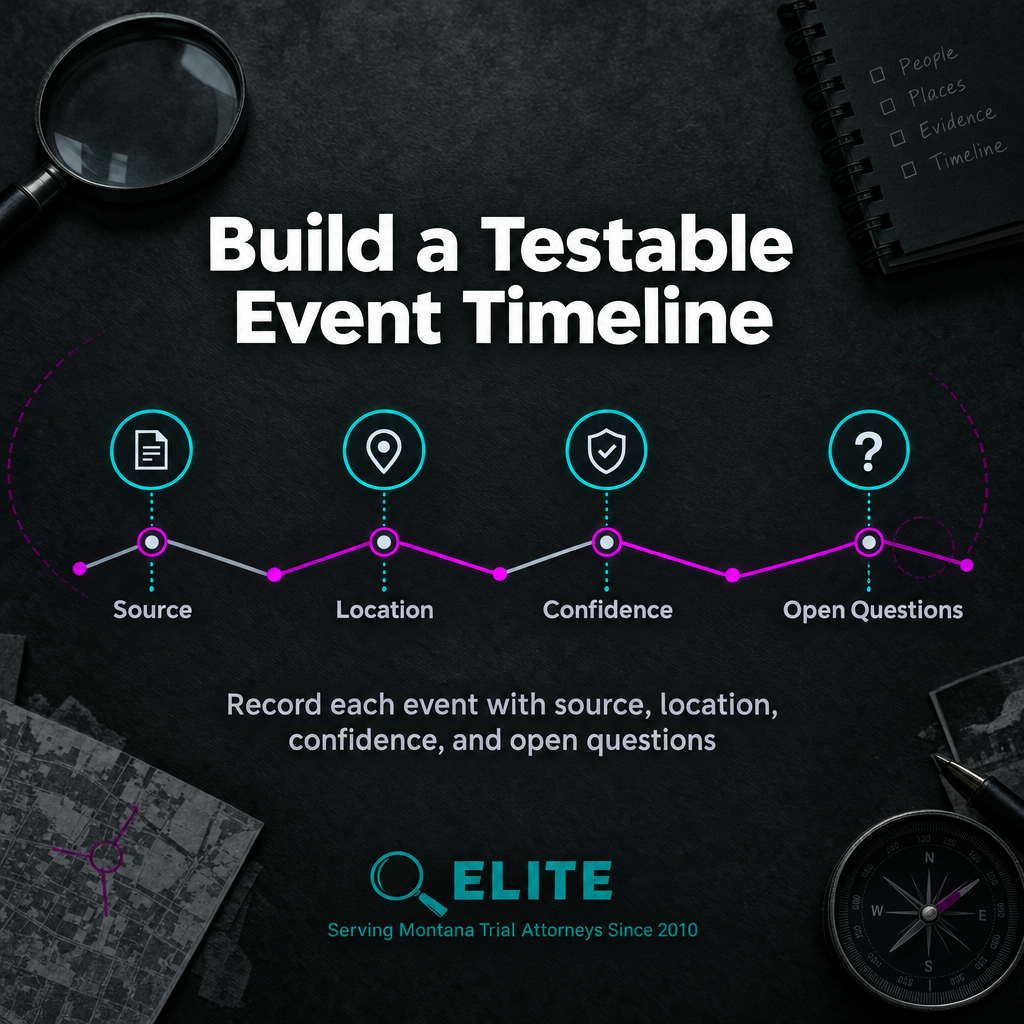
A professional chronology should show the date or time range, event, source, location, people involved, confidence level, and unresolved question for every significant entry. That format lets an attorney review not only what the investigator found, but also how strongly each finding supports the sequence.
Investigators should distinguish direct observations, document-supported facts, online leads, witness recollections, and reasonable inferences. They should also check timestamps, time zones, duplicate records, edited or deleted content, conflicting accounts, and gaps that require follow-up.
The final documentation should be suitable for attorney review and should explain whether each finding supports, challenges, or fails to resolve a timeline point. A clear report does not hide uncertainty; it identifies where additional work may change the sequence.
Turning findings into a usable chronology
Use one entry for each meaningful event and attach the source or sources that support it. Include a confidence label and a short explanation of why the entry belongs in that position.
When several sources describe the same event, keep them linked rather than treating them as unrelated facts. This makes duplicate information easier to recognize and shows whether independent sources actually add confirmation.
Checking contradictions before relying on a date
Before relying on a date, compare the timestamp with time-zone settings, document creation details, surrounding communications, location information, and witness recollections. A date that appears exact may still describe when content was posted, recorded, received, or later modified.
Contradictions should remain visible in the report until resolved. Recording the conflict allows attorneys and individuals to decide whether more interviews, records, or surveillance are justified.
When to expand the inquiry or contact an investigator
Expand the inquiry when a key witness is missing, accounts conflict, misrepresentation is suspected, activity crosses jurisdictions, or the timeline could affect a legal decision. An online search may identify the gap, but another method may be needed to address it.
Surveillance, witness locating and interviews, background investigations, asset searches, corporate investigations, and risk and liability investigations may each serve a defined purpose. The right choice depends on the unresolved question, available records, location, timing, and applicable legal requirements.
Elite Investigations is a local option for attorneys, law firms, and individuals seeking investigative support in Montana and Wyoming. Our team provides professional investigation services to attorneys in Billings, Montana, and surrounding areas, including Wyoming, with work centered on complex cases.
Warning signs that an online search is insufficient
An online search is insufficient when the decisive fact depends on a private conversation, a missing witness, physical location, records not available publicly, or conduct that must be observed and documented through another method.
Conflicting accounts, unclear identities, multiple jurisdictions, and a timeline tied to an immediate legal decision are also reasons to discuss broader investigative options. The goal is to address the specific gap, not to order every service without a defined purpose.
How to start with Elite Investigations
Start by preparing the intake checklist, identifying the most important unresolved date or event, and gathering the records already available. Then contact Elite Investigations through its contact page or call +1 406-698-8911 to discuss the inquiry, geographic coverage, suitable methods, and documentation needs.
Our team can help frame the timeline question before the scope is set. For attorneys and law firms considering when investigative support belongs in a case, our related guidance on bringing a private investigator into a case may also help organize that conversation.
Frequently Asked Questions
How do I get started with online private investigation services for a legal timeline?
Prepare the central question, relevant date range, names, locations, existing records, and known gaps. Contact an investigator to discuss scope, suitable methods, geographic coverage, documentation, and next steps.
What is included in an online social media investigation?
The scope may include reviewing relevant public online information connected to identified people, dates, accounts, locations, or events. Ask which sources will be reviewed, how findings will be documented, and what limitations apply.
Is this type of investigation suitable for attorneys, law firms, and individuals?
It can help anyone who needs a clearer sequence of events, but the appropriate scope depends on the legal or factual question. Attorneys and firms can define case needs, while individuals should bring organized records and explain the decision the findings must support.