GPS Tracking Investigations in Billings, MT
When a subject’s movements matter to an investigation, accurate location information can help establish a clearer picture of where a vehicle has traveled, when it moved, and where it stopped.
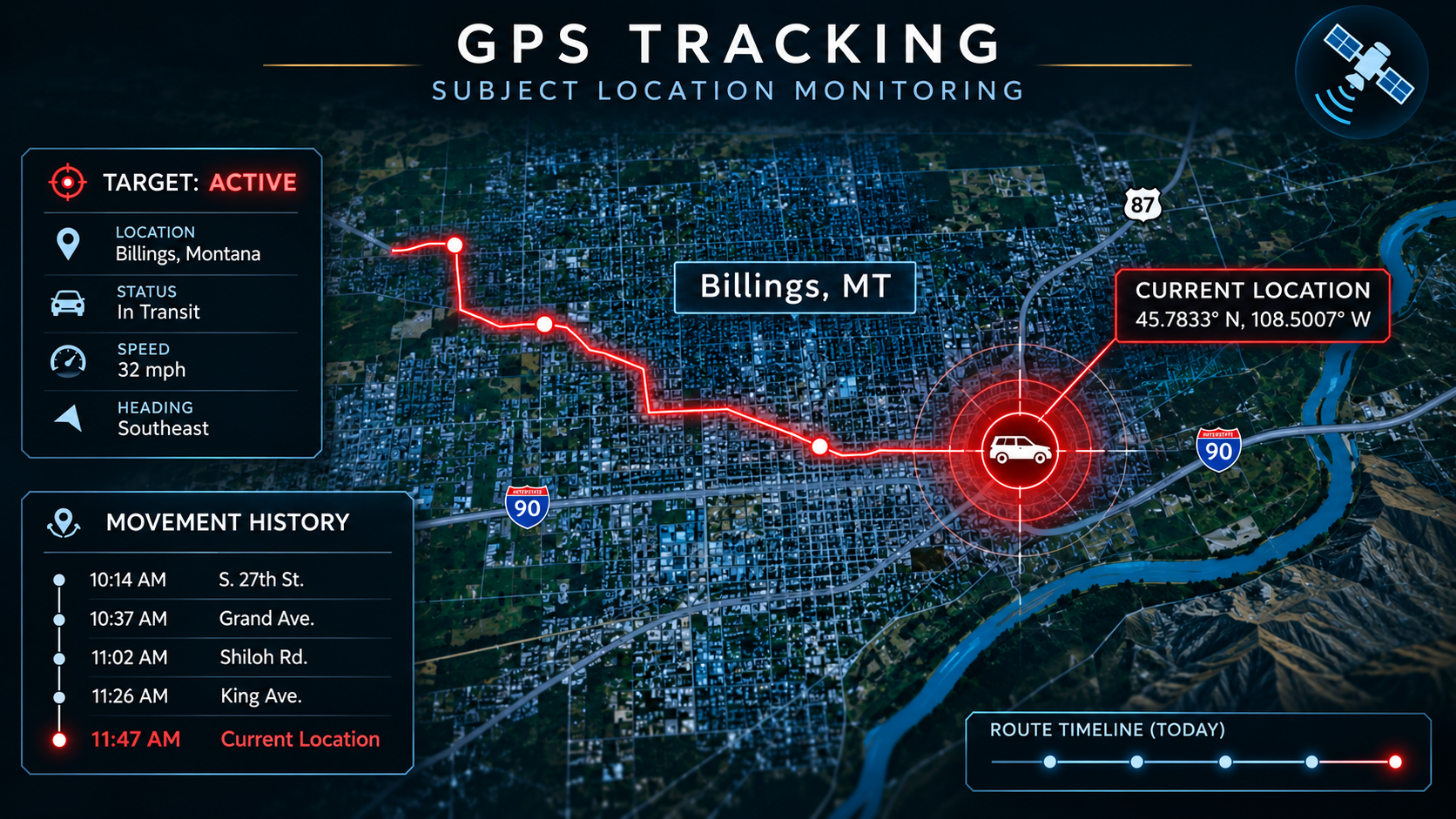
Where Did the Vehicle Go? When Was It There?
GPS tracking investigations concern a subject’s whereabouts and movements, not navigation assistance or directions.
Elite Investigations provides professional investigative services in Billings, Montana, including GPS-related vehicle tracking where legally permissible. Location information can help develop leads, identify movement patterns, and support broader investigative work.
Every assignment requires an appropriate legal basis. GPS data may indicate the position of a device or vehicle, but does not independently establish who was driving or what occurred at a destination.
Movement Patterns. Locations. Timelines.
Depending on the equipment, authorized access, and conditions of the assignment, location records may provide several useful forms of data.
Vehicle Whereabouts
Location points can indicate where a monitored vehicle was positioned at a recorded time, subject to GPS accuracy and signal limitations.
Movement History
Available location records may help reconstruct travel between places and identify movement during a defined investigative period.
Stops & Time Patterns
Repeated stops, travel intervals, and approximate durations may provide context for a specific investigative question.
Time-Stamped Records
Where available, time-stamped location information can assist with chronological comparisons against other lawful evidence.
Surveillance Coordination
Authorized GPS information may complement field surveillance by identifying relevant locations or time periods for further observation.

The Pattern Can Matter More Than the Pin.
A single location point rarely tells the whole story. Investigators may need to understand movement across multiple locations and compare those records with other evidence.
Patterns of movement may identify locations that warrant additional research.
Recorded times can help investigators compare vehicle activity with known events or statements.
GPS records may need corroboration through observation, records, interviews, or other lawful methods.
Turning Location Points Into a Timeline
Sample location point
Sample travel interval
Sample stationary period
Sample final location point
This timeline and the Billings tracking dashboard are conceptual illustrations. They do not represent a real person, monitored vehicle, active tracking session, or actual investigative findings.
When Vehicle Location Information May Be Relevant
GPS-related investigative work must be supported by lawful authority and a clearly defined investigative purpose.
Civil Investigations
Where authorized, location information may help counsel evaluate travel-related questions, timelines, and relevant movement in civil matters.
Insurance & Claims Investigations
Properly obtained location records may support an investigation into disputed travel or activity when the data is relevant to a legitimate claim.
Authorized Vehicle Monitoring
Vehicle location monitoring may be appropriate when the person requesting the service has the necessary legal authority and the method is lawful.
Attorney-Directed Casework
Legal teams may seek assistance evaluating existing, lawfully obtained GPS records or determining whether location evidence could support a specific inquiry.
Technology Must Follow the Law.
GPS tracking raises important privacy, property, and legal questions. The ability to track a vehicle does not automatically create the right to do so.
Elite Investigations evaluates the proposed assignment and its legal context before determining whether a GPS-related method is appropriate.
A request to monitor another person’s whereabouts does not, by itself, establish legal authority to place a device or obtain private location data.
Responsible GPS Investigations
The proposed tracking method must have a valid legal basis under applicable law.
Vehicle ownership, consent, access, location, and the nature of the assignment may affect what is permitted.
Device accuracy, signal gaps, timestamps, and data limitations must be considered when reviewing location records.
Relevant information should be documented and preserved appropriately for the purpose of the investigation.
Investigative Judgment Still Matters.
Elite Investigations is led by Mike Toth, a private investigator based in Billings, Montana.
With more than 20 years of law enforcement experience, including service as a patrol officer, detective, and sheriff, Mike brings extensive investigative experience to complex assignments.
Location Data Is One Part of a Larger Investigation.
Elite Investigations supports attorneys with investigative research, surveillance, witness-related work, and other case-specific services throughout Montana and surrounding areas.
GPS-related findings are most useful when evaluated alongside the facts, legal questions, and other available evidence.
“Mike is a great investigator and great resource. I highly recommend his work and will certainly retain his services in the future.”Shane Colton, Attorney
Edmiston & Colton Law Firm
GPS Tracking Investigation FAQs
Understanding what GPS technology can establish, its limitations, and when investigative use may be lawful.
Can a private investigator track someone’s vehicle?
GPS tracking may be permissible in certain circumstances, but legality depends on applicable law, the vehicle, authorization, the proposed method, and the investigative purpose. A private investigator cannot assume that tracking a third party is lawful.
Can GPS tracking show where a vehicle has been?
Depending on the system, authorized GPS data may provide time-stamped location points and historical movement records. Accuracy and completeness vary by device, environment, signal, and data availability.
Can GPS tracking prove who was driving?
No. GPS information generally identifies a device’s reported location, not the identity of the driver or passengers. Additional lawful evidence would be required to establish those facts.
Can GPS records be used in court?
GPS records may be relevant to legal proceedings, but admissibility depends on how the data was obtained, authenticated, preserved, and presented, as well as the applicable rules of evidence. An attorney should evaluate those issues.
Can I request GPS tracking of a spouse or another person?
You can discuss your investigative concerns, but a relationship to the person does not automatically authorize tracking. Elite Investigations must assess the proposed work and its legal basis before proceeding.
Does GPS tracking replace physical surveillance?
No. GPS information may complement authorized surveillance, but location data alone cannot establish everything a person did at a particular place. The appropriate method depends on the case.
How much does a GPS tracking investigation cost?
Costs depend on the legal and practical scope, assignment duration, equipment needs, data review, reporting, and any related surveillance. Contact Elite Investigations to discuss the proposed work.
Need Answers About a Vehicle’s Movements?
Discuss your investigative objectives with Elite Investigations. We’ll help assess the appropriate scope and whether lawful GPS-related investigative services may fit your case.
100 N. 27th Street, Suite 600-B, Billings, MT 59101
406-698-8911 | info@elitepimt.com