A statement can sound credible and still leave important questions unanswered about timing, firsthand knowledge, supporting records, and what the speaker actually observed. We help attorneys and individuals test those details against witnesses, records, public information, social media, and carefully planned observation so legal counsel can evaluate organized factual findings.
Why a believable statement may still need independent verification
A believable statement may still need independent verification when its timing, source, or supporting facts have not been tested. In civil disputes, criminal matters, workplace investigations, liability claims, family-related disputes, and complex attorney-led cases, one account can influence a major legal decision before anyone confirms the surrounding facts.
We do not treat an allegation as an established fact simply because it sounds consistent. Our role is to identify checkable details, seek corroboration, document inconsistencies, and preserve information for legal review. An investigator can organize factual information, but legal strategy, admissibility, and the significance of evidence belong to the attorney and, ultimately, the court.
Separate firsthand observations from assumptions and hearsay
The first question is what the speaker personally saw, heard, or did. We distinguish direct observations from conclusions, assumptions, and information repeated by someone else because each type of information carries a different level of reliability for legal review.
This distinction also helps reveal whether several accounts are genuinely independent or whether they all repeat the same original source. A report should identify those differences plainly rather than quietly treating every statement as firsthand evidence.
Identify missing details before relying on an account
Missing details often matter as much as apparent contradictions. We look for the claimed date, time, location, participants, sequence of events, source of knowledge, and documents or communications that could confirm the account.
That process gives counsel a clearer question to investigate. It may show that a statement needs further interviews, a records search, social media review, surveillance, or no additional work because the available information already answers the issue.
How investigators test a statement against a reliable timeline
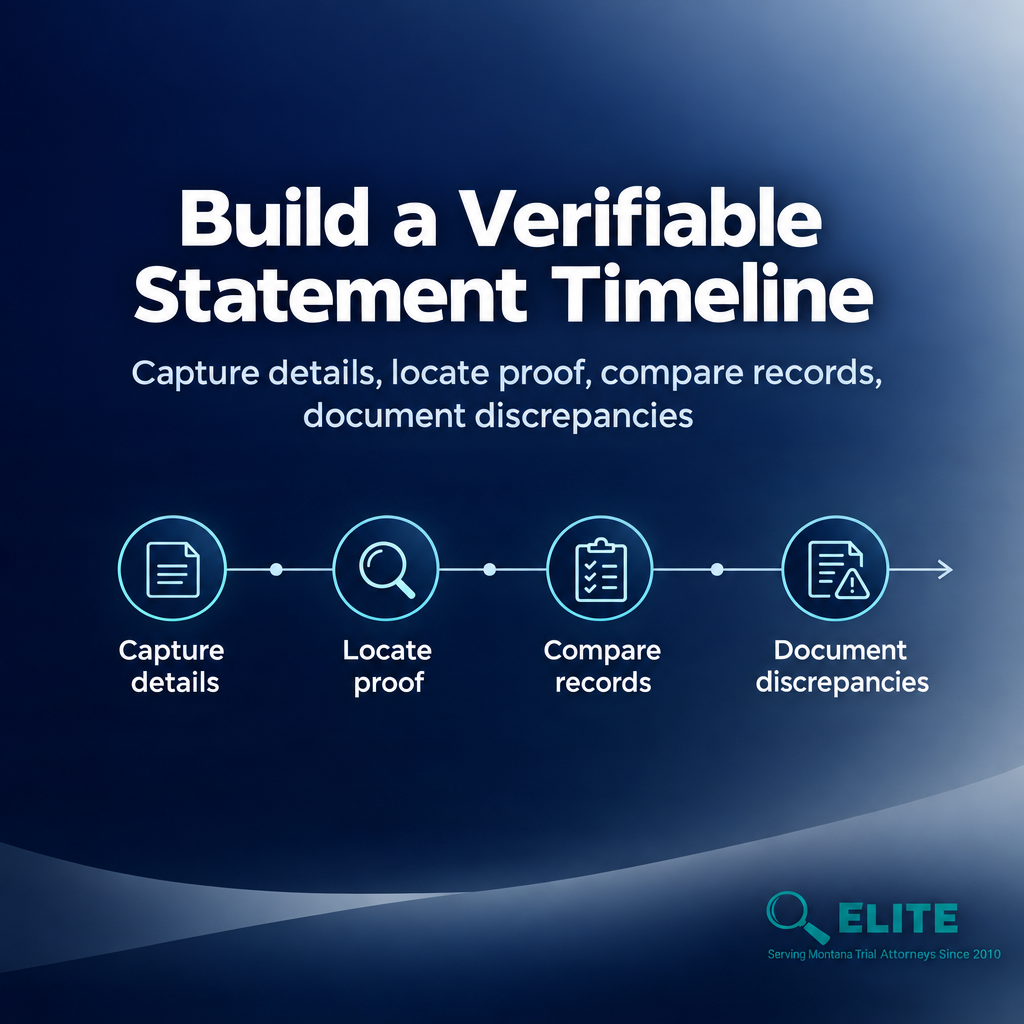
A reliable timeline begins with the original account and turns general assertions into specific, checkable points. We record the claimed date, time, location, participants, sequence of events, and what the speaker personally observed before comparing that account with available information.
Depending on the assignment, comparison sources may include records, public information, communications supplied by the client, location details, and witness recollections. A discrepancy does not automatically prove deception. Memory limits, unclear wording, incomplete records, and ordinary uncertainty can all produce differences that require careful interpretation.
- Capture the original statement: Preserve the wording, date, speaker, and context.
- Mark checkable claims: Separate locations, times, actions, and named people.
- Seek corroboration: Identify records, witnesses, or public-facing information that may confirm or challenge each point.
- Document the result: Record source details, limitations, and unresolved conflicts.
Build the chronology from fixed points
Fixed points such as appointment records, dated messages, business transactions, known travel, or independently documented events can anchor a chronology. We then place the disputed statement around those points and identify where the sequence is supported, uncertain, or inconsistent.
This approach reduces reliance on memory alone. It also helps attorneys see which unanswered question deserves additional investigation and which apparent conflict has a reasonable explanation.
Compare travel, communication, and activity details
Travel, communication, and activity details can test whether an account fits the claimed time and place. We may compare supplied messages, public-facing information, location descriptions, witness recollections, and other lawful sources relevant to the assignment.
The comparison must remain disciplined. A digital timestamp or online activity may show that an account or device was active, but it may not prove who was present or what happened offline.
Which investigative methods can confirm or challenge an account?
The right investigative method depends on the precise claim being tested, not on a fixed checklist. Witness locating and interviews may clarify firsthand knowledge, records research may test dates or relationships, and surveillance may address a specific conduct or location question when legally and practically appropriate.
Purpose-specific methods can include background checks, asset searches, bank account searches, public-facing information research, and social media investigations. These tools are not automatic steps in every matter. We recommend selecting them based on the legal question, available information, safety, privacy, and attorney guidance.
Witness interviews and locating people with relevant knowledge
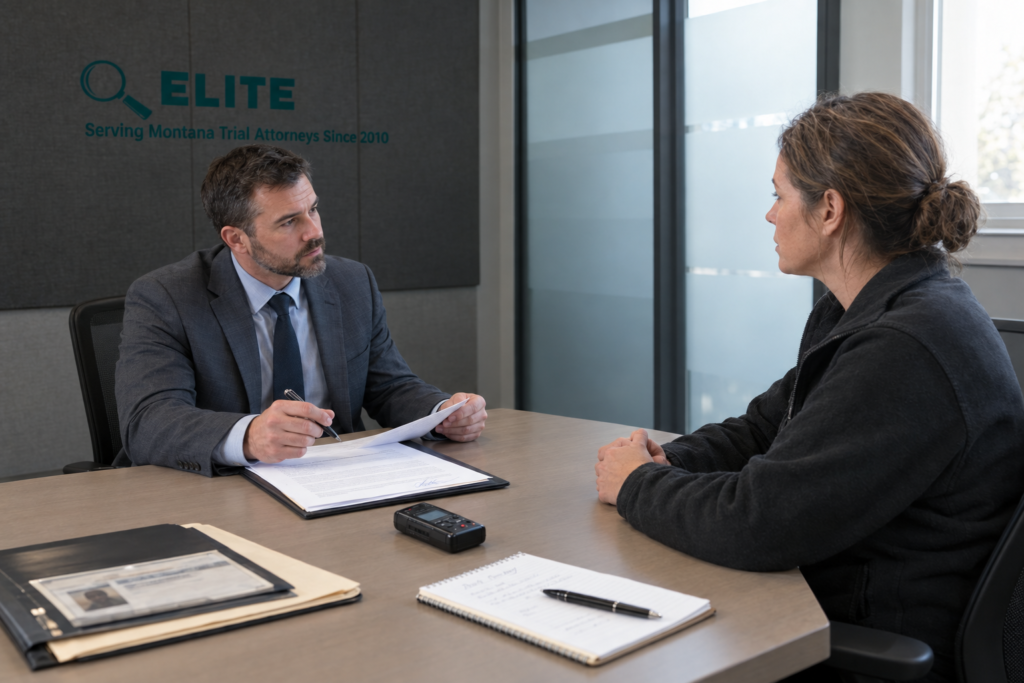
Witness locating and interviews can identify people who directly observed an event, clarify the order of events, and distinguish personal knowledge from repeated information. Interview planning should account for the witness’s relationship to the parties, possible bias, memory limits, and the exact issue counsel needs addressed.
Locating a person may also reveal that an account depends on an unavailable or misidentified source. We document what the witness says, how the information was obtained, and any limitations on the interview.
Records, background, and social media research
Records, background checks, asset searches, bank account searches, and public-facing information each answer different questions. Social media research may include public profiles, posts, images, videos, dates, locations, usernames, linked identities, and changes over time.
Where appropriate, investigators should preserve URLs, timestamps, screenshots or captures, and surrounding context. Online material must be interpreted carefully because a public post can show what was published without proving the underlying event, identity, or meaning.
Targeted surveillance when observation is legally and practically appropriate
Targeted surveillance can help test a specific conduct or location-related claim when observation is lawful, safe, and proportionate to the assignment. The scope should be defined in advance with attention to legal requirements, practical limitations, and attorney guidance.
Surveillance findings should describe what the investigator observed, when and where the observation occurred, and what remained outside the investigator’s view. Observation can support or challenge an account, but it does not automatically establish intent or resolve every legal issue.
What does a social media search cost and what affects its scope?
The cost of a social media search depends on its scope, and no business-specific price is provided in the available information. Factors can include the number of identities and platforms, search depth, date range, access limitations, preservation needs, identity confirmation, and the detail required in the final report.
A focused search for specified public profiles differs from a wider inquiry involving aliases, multiple platforms, historical posts, image review, linked identities, or changes over time. To define the assignment, provide known names and aliases, usernames, relevant dates, locations, platform concerns, the statement being tested, and the decision the findings will support.
We recommend lawful access methods and clear source limitations. Investigators should avoid presenting online material without context and should distinguish a public post from proof of the event described in a legal matter.
Define the assignment before searching
The assignment should identify whose online activity matters, which platforms or dates are relevant, and what statement the search is intended to test. A clear question prevents time spent collecting material that has no connection to the legal issue.
Known usernames, aliases, profile links, locations, and date ranges can improve the search plan. Counsel should also identify deadlines and whether preservation requires captures or a more detailed record of the material reviewed.
Match the reporting level to the legal question
The report should match the question’s importance and complexity. A focused profile review may need a concise source summary, while a broader inquiry may require identity analysis, historical review, preserved exhibits, chronology, and explanation of access limitations.
The goal is usable information, not a large collection of unconnected posts. We recommend deciding in advance what counsel needs to evaluate the statement and how the findings may fit the broader investigation.
How findings should be preserved and reported for legal review
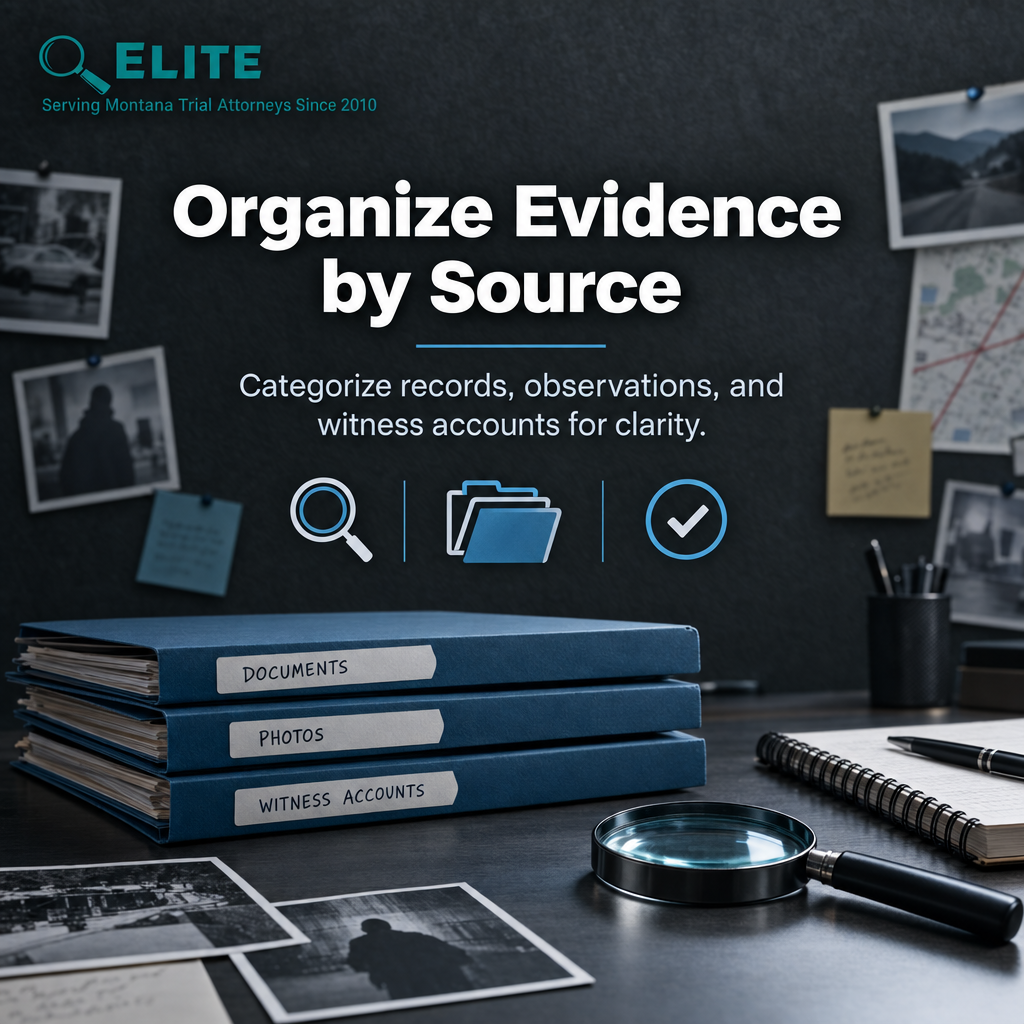
A useful investigative report separates direct evidence, an investigator’s observation, a witness account, public online material, and hearsay reported by another person. That separation allows attorneys to evaluate the source and weight of each item without confusing an inference with an established fact.
A practical report may include the assignment scope, methods, chronology, source notes, interview summaries, exhibits or preservation details, corroboration, inconsistencies, limitations, and unresolved questions. Accurate wording matters: the report should state what the investigator observed or located rather than promise a legal result.
Counsel can then decide how the findings fit discovery, negotiation, motion practice, trial preparation, or further investigation. Our work supplies organized factual information for that review; it does not replace legal advice or the court’s role.
Protect source context and chain-of-information details
Source context explains how information entered the investigation. We record whether a detail came from a direct observation, an interview, a supplied document, public online material, or a person repeating another source.
Preservation details can include when material was located, what appeared with it, how it was captured, and what access limitations existed. These details help attorneys assess reliability and decide what additional authentication or investigation may be needed.
Write findings that attorneys can evaluate
Attorneys need findings stated with precision, including what supports an account, what challenges it, and what remains unresolved. We recommend separating observed facts from interpretation and identifying gaps rather than filling them with assumptions.
A clear chronology, source notes, interview summaries, and limitations make an investigative report easier to use. Counsel can then determine whether the information supports a legal position, requires follow-up, or has limited relevance.
When should an attorney or individual request investigative help?
Request investigative help when a key witness cannot be located, accounts conflict on material details, a timeline depends on missing records, online information may disappear, or a statement affects a significant legal decision. Early planning can preserve options while names, records, and public information remain easier to locate and compare.
Before contacting an investigator, gather the original statement, known names and aliases, dates, locations, relevant documents, existing case deadlines, and the specific question the investigation must answer. A focused assignment helps determine whether witness interviews, surveillance, background checks, social media investigations, asset searches, or another method is appropriate.
Prepare a focused assignment
A focused assignment states the claim to test, the relevant time period, the people or locations involved, and the result counsel or the individual needs to evaluate. Include known limitations, such as missing records, uncertain identities, safety concerns, or a short preservation deadline.
This preparation does not require you to choose the investigative method yourself. It gives the investigator enough context to discuss lawful options, likely information needs, and the boundaries of the work.
Choose local support for Montana and Wyoming matters
Elite Investigations is a Billings, Montana firm serving attorneys and individuals in Montana and Wyoming. Our services include legal investigations, civil and criminal investigations, witness locating and interviews, surveillance, background checks, social media investigations, and asset searches.
We also bring more than 24 years of experience in law enforcement and private investigation, including work involving complex investigative needs. To discuss the assignment, service area, scope, and information needed to begin, contact Elite Investigations at +1 406-698-8911 or info@elitepimt.com.
Frequently Asked Questions
How do investigators verify whether a statement is reliable?
Investigators compare the statement with a documented timeline, witness interviews, available records, public-facing information, social media research, and targeted surveillance when appropriate. They report corroboration, discrepancies, source limitations, and unresolved questions without deciding whether the statement is legally true.
What can a social media investigation include?
A social media investigation may include lawful review of public profiles, posts, images, videos, usernames, dates, locations, linked identities, and changes over time. Scope depends on the platforms, identities, date range, preservation needs, and reporting requirements, and online material must be interpreted in context.
How much does a social media search cost?
No business-specific price is provided in the available information. Cost typically depends on the number of identities and platforms, historical depth, identity research, preservation work, search scope, and report detail, so request a scope-based estimate from Elite Investigations.
Can an investigator determine whether someone lied?
An investigator can test claims against evidence, identify inconsistencies, interview witnesses, and document observations. Investigators should not present an inference as proof of deception; an attorney or court evaluates the legal significance of the findings.
Does Elite Investigations serve Billings and areas outside Montana?
Elite Investigations serves Billings, Montana, surrounding areas, and Wyoming, with business information also identifying coverage across Montana communities. Contact the firm to confirm whether the assignment location and required method fit the available service area.